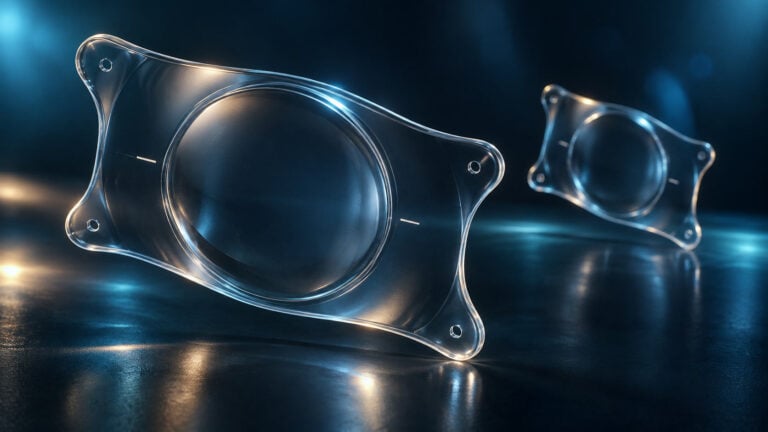
Implantable contact lenses, often referred to as ICLs, are designed to last a lifetime. In most cases, the lens remains stable in the eye for decades without needing replacement. That said, natural age-related changes, such as cataracts, may still require treatment later in life.
The Real Answer for Patients
When someone asks this question, they’re not just thinking about time.
They’re really asking whether it’s worth it. Whether the results will last. Whether they’ll end up needing another procedure down the line. The reassuring part is this, modern implantable lenses are built for the long term.
Advanced lenses, such as the EVO ICL used by clinics like EuroEyes, are made from biocompatible materials that don’t degrade inside the eye. They don’t wear out in the way people often imagine, and they don’t need replacing like traditional contact lenses.
In clinical terms, they’re considered a long-term, often lifetime solution. Many patients maintain stable, high-quality vision for 15 to 20 years and beyond, and most will never need a replacement at all.
Why Implantable Contact Lenses Last So Long
One of the main reasons ICL lenses last is the material they’re made from.
Modern lenses use something called Collamer, a blend of collagen and highly purified polymers designed specifically for use inside the eye. Unlike surface lenses, these sit in a protected position behind the iris, where they’re not exposed to air, dust, or daily wear.
That placement makes a difference.
The material itself is designed to work in harmony with the eye. It doesn’t trigger irritation or rejection, and it doesn’t break down over time. It also allows oxygen to pass through naturally, helping to maintain a healthy internal environment.
In simple terms, the lens isn’t something your body fights against, it becomes part of the system. That’s why, once it’s in place, it tends to stay stable for years.
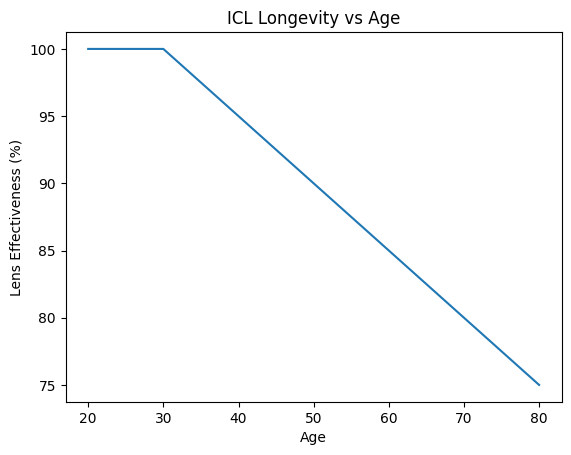
This chart reflects how vision changes over time due to natural ageing of the eye, not deterioration of the lens itself. Implantable contact lenses remain stable, but factors such as presbyopia and cataracts can influence overall visual performance later in life.
What Are Implantable Contact Lenses Made Of?
Modern ICL lenses, including EVO ICL, are built from a carefully engineered material rather than a single substance.
At a basic level, Collamer includes:
- Collagen, a natural protein found in the eye, which improves compatibility
- Hydrophilic polymers, which help the lens remain soft, flexible, and stable
- UV-filtering elements, designed to protect the eye from long-term exposure
What matters here isn’t just the ingredients, it’s how they behave together.
Older lens materials were more rigid and less integrated with the eye’s environment. Collamer was developed to do the opposite, to sit comfortably inside the eye and remain stable over time.
How Long Do the Results Actually Last?
This is where expectations need to be clear.
The lens itself doesn’t “wear out”, but your eyes will still change naturally as you age.
For example, many people develop presbyopia in their 40s or 50s, where near vision becomes more difficult. Later on, usually from the 60s onwards, cataracts can develop as the eye’s natural lens becomes cloudy.
These changes are not caused by the implantable lens. They would happen anyway.
What ICL does is correct your current prescription in a stable, long-term way. One of the advantages is that it doesn’t permanently alter the structure of the eye, which means it can be adapted in the future if needed.
Do Implantable Lenses Ever Need Replacing?
In most cases, no.
Once an implantable contact lens is in place and functioning well, it’s designed to stay there for the long term. For the majority of patients, it becomes a stable part of their vision system rather than something that needs ongoing attention.
That said, there are a few situations where changes might be needed over time:
- Development of cataracts later in life
- Significant prescription shifts, which are uncommon in stable adults
- A decision to upgrade to newer lens technology in the future
To put that into perspective, think of a patient in their late 20s who has ICL surgery to correct a high prescription. Their vision remains stable for many years, often into their 40s or 50s, without needing any change at all. Then, like most people, they begin to notice reading becoming more difficult due to presbyopia. That isn’t a failure of the lens, it’s simply the natural ageing of the eye.
Another common scenario is later in life, usually in the 60s or beyond, when cataracts begin to develop. At that point, the natural lens of the eye becomes cloudy and needs to be replaced. During cataract surgery, the implantable contact lens can be removed at the same time, and a new intraocular lens is inserted to restore clarity. It’s a planned transition rather than an unexpected complication.
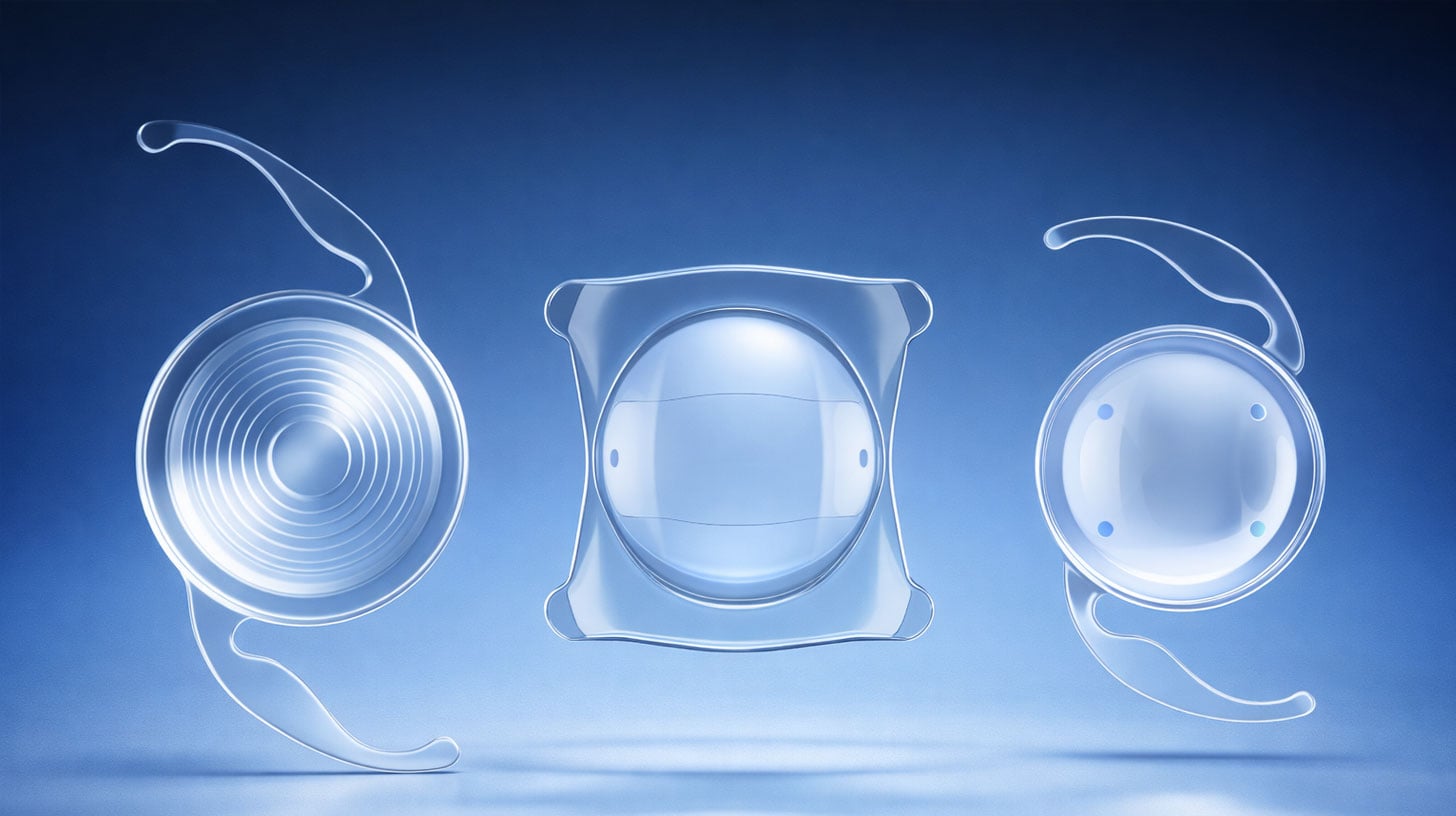
There are also patients who, years down the line, choose to upgrade their vision. For example, someone who originally had ICL for distance vision might later decide they want more independence from reading glasses. In those cases, newer lens technologies, such as multifocal or extended depth-of-focus lenses, can be considered. Because ICL is removable, that option remains open.
This is where the real advantage of ICL becomes clear.
Unlike laser eye surgery, where the cornea is permanently reshaped, implantable lenses don’t lock you into a single outcome. If your eyes change, or if your needs change, the treatment can adapt with you.
It’s less about “fixing” vision once and for all, and more about giving you a long-term solution that still leaves room for flexibility in the future.
How This Compares to Other Vision Correction Options
Laser Eye Surgery: LASIK and SMILE
Laser eye surgery reshapes the cornea to correct vision. It’s highly effective and offers quick recovery, which is why it’s widely used.
But it’s also permanent.
Once tissue is removed, it can’t be put back. Enhancements may be possible, but they depend on how much corneal thickness remains. So while results are long-lasting, there’s less flexibility if your vision changes later.
Glasses and Contact Lenses
Glasses and contact lenses are the most familiar option, but they’re also ongoing.
Prescriptions change, lenses need replacing, and contact lenses require daily handling. Over time, the cost and inconvenience can add up, especially for people with active lifestyles.
It’s a way of managing vision, rather than correcting it.
ICL: Implantable Contact Lenses
ICL sits somewhere different.
Instead of reshaping the eye, it adds a lens inside it. That preserves the natural structure of the cornea and makes it suitable for a wider range of patients, including those with higher prescriptions or thinner corneas.
The lens itself is stable, biocompatible, and designed to last for decades. It’s also removable and upgradeable, which gives it a level of flexibility that other treatments don’t offer.
This is why clinics like EuroEyes often position it as a more future-focused option.
Why ICL Is Considered a Future-Proof Solution
When you look at all three options together, the difference becomes clearer.
Laser offers permanence. Glasses offer flexibility but require constant upkeep. ICL sits between the two, long-term stability with the option to adapt.
That balance is what makes it appealing.
Rather than locking your vision into a single correction, it allows for changes over time. For patients thinking long term, that can be an important factor.
For Most Patients
For most people, implantable contact lenses are not something you replace every few years.
They’re designed to stay in place and deliver consistent, high-quality vision for decades.
In reality, the question shifts slightly.
It becomes less about how long the lens lasts, and more about how long you want to live without relying on glasses or contact lenses. At EuroEyes London, the focus is on long-term outcomes. That means combining advanced treatments like EVO ICL with detailed diagnostics and personalised planning. There isn’t a one-size-fits-all answer. But there is usually a solution that fits the eye in front of you.