A Surgeon’s Perspective on Modern Vision Correction
For many years, LASIK has been the most recognised name in laser eye surgery. For the right patient, it remains an excellent treatment. However, as eye care has advanced and patient expectations have changed, more people are now discovering implantable lenses as an alternative.
At EuroEyes, we see this shift every day. Patients are no longer just asking how to get rid of glasses. They want to know which option will protect their eyes long-term, preserve visual quality, and adapt with them as they age.
This is where the comparison between implantable lenses and LASIK becomes important.
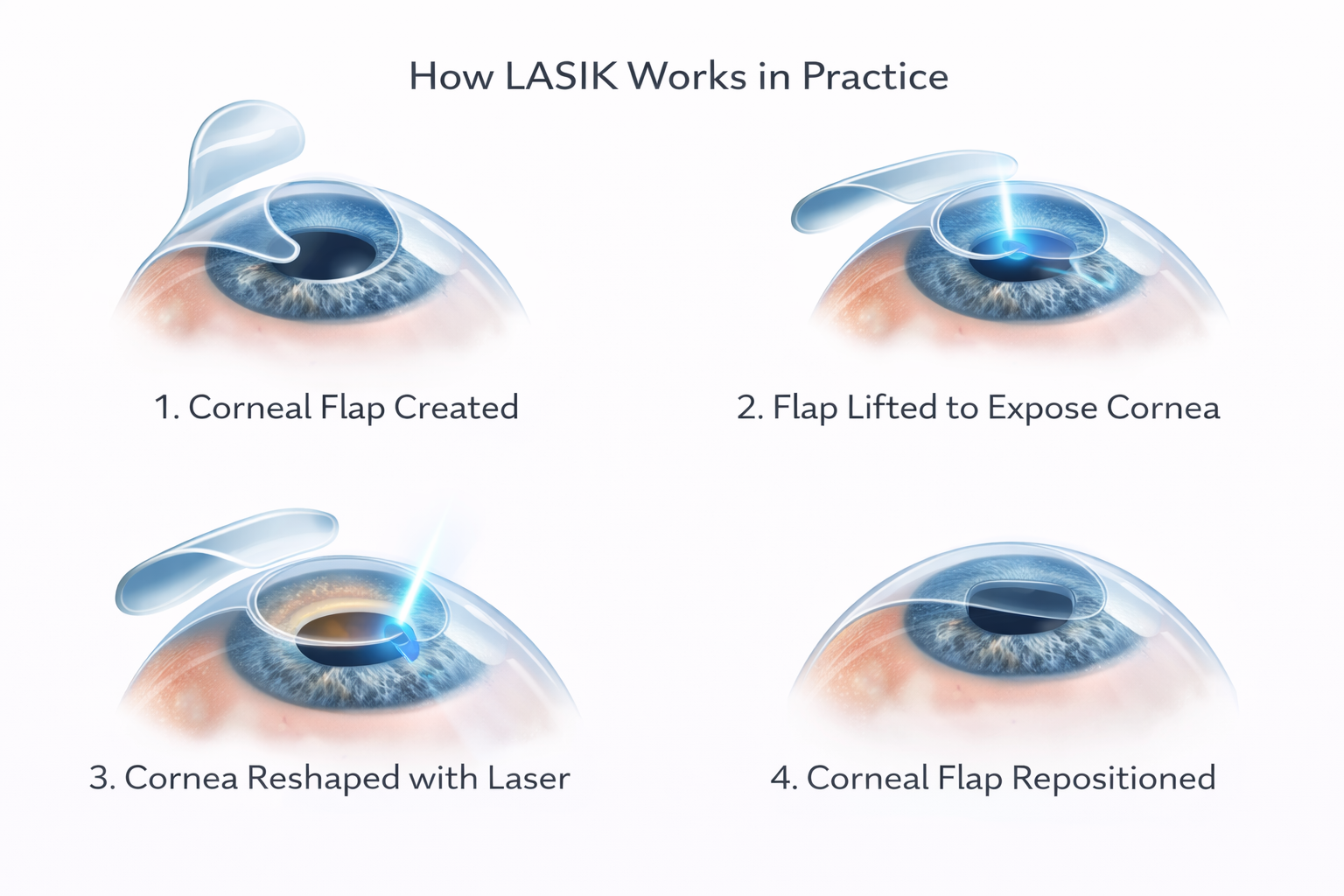
How LASIK works in practice
LASIK corrects vision by reshaping the cornea, the clear front surface of the eye. By removing microscopic amounts of corneal tissue, light is redirected so it focuses more accurately on the retina.
For patients with healthy, stable corneas and mild to moderate prescriptions, LASIK can deliver excellent results. Vision often recovers quickly, and many people enjoy years of clear sight without glasses or contact lenses.
However, LASIK permanently changes the structure of the cornea. Because tissue is removed, the procedure depends heavily on corneal thickness, shape, and long-term stability. This means LASIK is not suitable for everyone, particularly those with thinner corneas, higher prescriptions, or existing dry eye symptoms.
How implantable lenses work differently
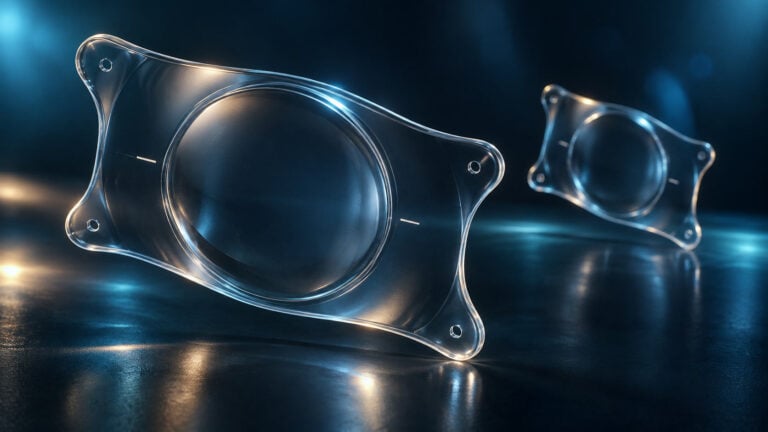
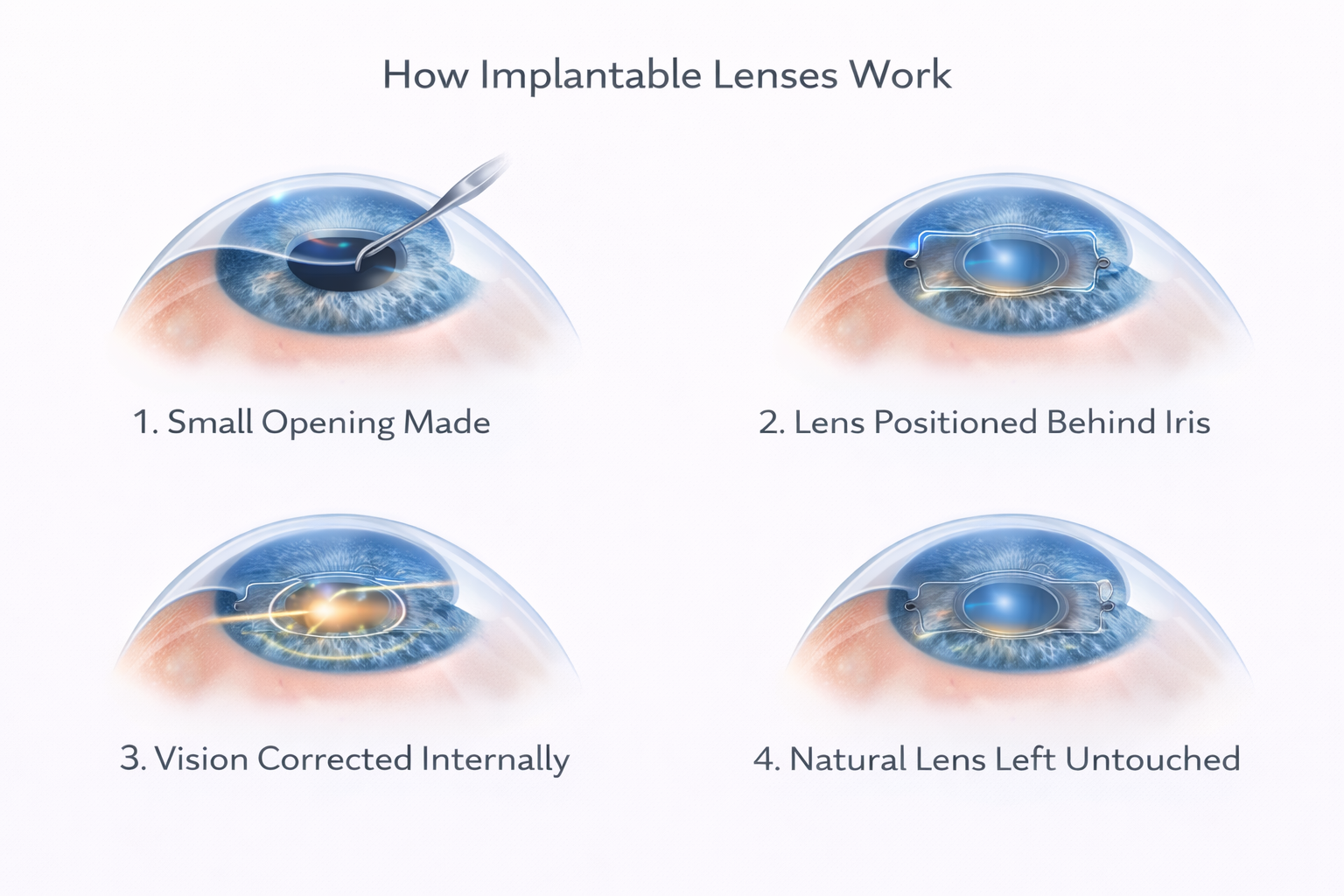
Implantable lenses, sometimes referred to as implantable contact lenses, take a fundamentally different approach. Instead of reshaping the eye, a precision-engineered lens is placed inside the eye, usually behind the iris and in front of the natural lens.
Nothing is removed. The cornea remains untouched.
The implant works alongside your natural eye structures, correcting vision internally rather than altering the eye’s surface. This makes implantable lenses particularly valuable for patients who have been told they are not suitable for LASIK or who want to preserve the integrity of their cornea.
A difference in philosophy, not just technology
One of the most important distinctions between LASIK and implantable lenses is philosophical rather than technical.
LASIK is a structural change. Once performed, the cornea cannot be returned to its original state.
Implantable lenses are additive. The lens can be removed or exchanged if needed in the future, which offers flexibility as the eye changes with age. This is increasingly relevant for patients in their late thirties, forties, and beyond, when natural focusing ability and lens clarity begin to change.
Visual quality and prescription range
For higher prescriptions, implantable lenses often provide superior optical quality. This is because extreme corrections do not need to be forced through corneal reshaping. Instead, the correction is handled by a lens designed specifically for that level of vision error.
Patients with strong short-sightedness, significant astigmatism, or complex prescriptions frequently achieve sharper, more stable vision with implantable lenses than would be possible with LASIK.
Clinical consideration
Enhance table for the final article – full overview and different lenses.
Why Lens Options Are Becoming Popular
In recent years, a variety of advanced lens options have emerged, making implantable lenses a highly attractive solution for vision correction. These lenses include options like light adjustable lenses (LAL), trifocal and extended depth-of-focus (EDOF) lenses, as well as options like the Rayner Galaxy series and other multifocal or monofocal lenses.
Each type of lens offers unique benefits. For example, light adjustable lenses allow fine-tuning of vision after surgery, providing a level of customisation that was previously unachievable. Trifocal and EDOF lenses help patients see clearly at multiple distances, reducing or even eliminating the need for reading glasses.
These advancements have made lens-based vision correction a popular choice for people looking for a long-term, adaptable solution that can evolve with their lifestyle and vision needs. It’s one of the reasons why more patients are exploring these options with their surgeons as part of a comprehensive eye health plan.

Dry eye and comfort considerations
Dry eye symptoms are one of the most common concerns we hear from patients considering laser eye surgery. Because LASIK involves cutting corneal nerves, it can temporarily worsen dryness and, in some cases, make it a long-term issue.
Implantable lenses do not interfere with the corneal surface. For patients who already experience dry or gritty eyes, this can be a decisive factor. Comfort, especially for screen users and contact lens wearers, is often noticeably better after lens-based correction.
Age and long-term planning
LASIK tends to suit younger patients best, particularly those under forty with stable prescriptions and healthy corneas.
Implantable lenses, on the other hand, fit naturally into a longer-term vision strategy. They can be used in younger adults with high prescriptions and remain relevant as patients approach the age where natural lens changes occur. If cataract surgery becomes necessary later in life, the implantable lens can be removed as part of that process.
This adaptability is one reason why lens-based correction has become a cornerstone of modern refractive surgery.
Is one option better than the other?
There is no single best solution for everyone. LASIK remains an excellent option for carefully selected patients, and implantable lenses are not a replacement for laser surgery in all cases.
What has changed is choice!
Modern eye care is no longer about fitting patients into one procedure. It is about selecting the right technology for the right eye at the right stage of life.
A surgeon’s closing thought
If you are deciding between LASIK and implantable lenses, the most important step is a thorough consultation that looks beyond prescription alone. Corneal structure, lifestyle, age, visual demands, and long-term eye health all matter.
The goal is not simply to see clearly next month, but to protect the quality of your vision for decades to come.