If you are both presbyopic and short-sighted, you may find yourself constantly switching between reading glasses and your everyday prescription glasses. Varifocal glasses offer a more convenient solution by combining near, intermediate and distance correction within a single pair of lenses. However, seeing clearly through varifocal lenses is not always as effortless as it sounds. You must learn to look through the correct section of the lens for each distance, which can take time and may continue to restrict how naturally you see and move.
EuroEyes, UK explores the most common problems associated with varifocal glasses, why some people struggle to adapt and how trifocal implantable lenses may offer a longer-term alternative for suitable patients.
Why Can Varifocal Glasses Cause Problems?
Varifocal glasses are designed to solve a common problem. Instead of using one pair of glasses for reading and another for driving, watching television or seeing into the distance, several prescription strengths are incorporated into a single lens. The upper part of the lens is generally used for distance vision, the middle section for intermediate activities and the lower area for reading and close-up tasks.
Unlike a natural, unrestricted field of vision, you must direct your eyes through a particular part of the lens to bring an object into focus. Looking through the wrong section can make your vision appear blurred or distorted. This is why new varifocal wearers often need time to adjust how they move their eyes, head and body. For some people, this adjustment happens relatively quickly. For others, the experience remains uncomfortable or restrictive despite having correctly prescribed glasses.
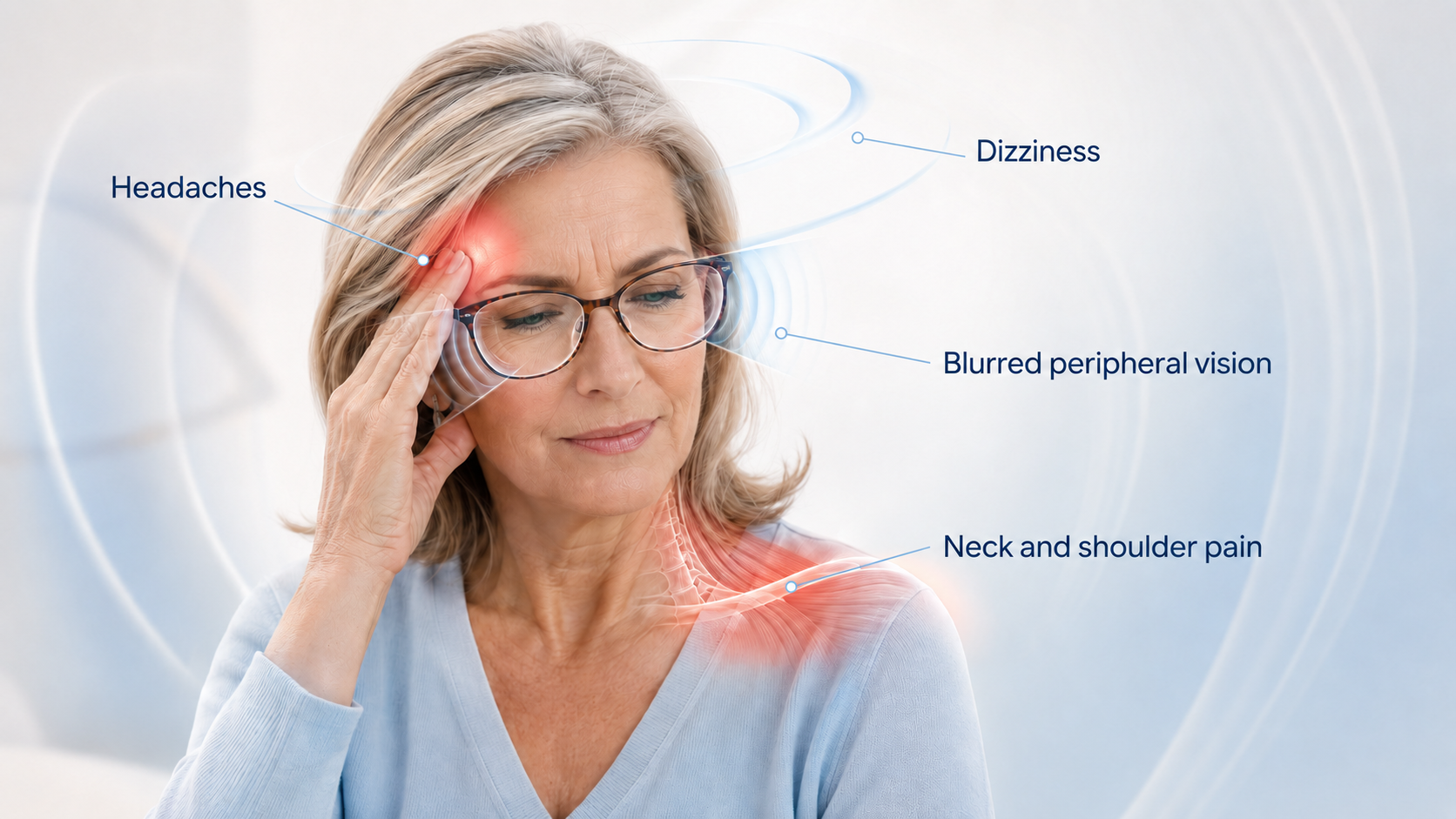
Common Side Effects of Varifocal Glasses
Problems can range from mild visual discomfort during the initial adjustment period to persistent headaches, dizziness, neck strain or blurred vision.
The severity of these symptoms can depend on your prescription, the quality and positioning of the lenses, the fit of the frame and how your eyes and brain respond to the different visual zones.
Headaches, Dizziness and Nausea
Headaches and dizziness are among the most frequently reported problems when adapting to new varifocal glasses.
Your brain must learn to process the rapid changes in focus produced as your eyes move between different parts of the lens. Peripheral areas may initially appear distorted, while objects can seem to move or “swim” when you turn your head. This can temporarily interfere with depth perception and spatial awareness, leading to headaches, disorientation, nausea or a feeling of being unsteady. These symptoms often improve as the brain adapts, but persistent discomfort should be checked by an optometrist.
Neck and Shoulder Pain
To see clearly through varifocals, you may need to move or tilt your head more frequently than you would with single-vision glasses.
This can become particularly noticeable when working at a computer. The intermediate zone of a varifocal lens can be relatively narrow, encouraging you to raise your chin, lean towards the screen or hold your head in an unnatural position. Over time, this posture may contribute to tension across the neck, shoulders and upper back. Some people eventually purchase a separate pair of occupational or computer glasses, meaning the varifocals no longer provide the complete all-in-one solution they expected.
Blurred Vision Caused by Measurement or Fitting Problems
Even high-quality varifocal lenses will not perform correctly if the measurements or fitting are inaccurate.
The optical centre of each lens must correspond precisely with the position of your pupils. The pupillary distance, fitting height, frame angle and distance between the lenses and your eyes can all affect how well the visual zones align. A frame that sits too high or too low may force you to lift or lower your head excessively to find the clearest part of the lens. Even relatively small inaccuracies can produce blurred vision, distortion and difficulty adapting. If your vision remains uncomfortable after several weeks, the prescription, measurements and frame position should be checked rather than assuming you simply need more time.
Fluctuating Vision
Varifocals may become more difficult to use when your prescription or visual performance is changing. Certain health conditions, including poorly controlled diabetes and some thyroid or blood-pressure-related problems, can contribute to fluctuations in vision. Changes affecting the eye itself, including the development of cataracts, may also alter the prescription over time.
Astigmatism adds another level of complexity because the lenses must correct the uneven curvature of the eye while also delivering the different focal zones required for near, intermediate and distance vision. If your eyesight changes regularly, a pair of varifocals that initially worked well may gradually become less effective.
Why Do My Eyes Look Bigger or Smaller Through My Glasses?
Prescription lenses can change the apparent size of your eyes. Lenses used to correct long-sightedness can magnify the eyes, while stronger short-sighted prescriptions can make them appear smaller. The effect is influenced by the strength of the prescription, lens thickness, lens material and the size and shape of the frame. Larger frames can make this effect more noticeable because more of the lens and its peripheral thickness remain visible.
Can Varifocal Glasses Increase the Risk of Falling?
The different focal zones within varifocal glasses can affect depth perception, particularly when looking down at steps, kerbs or uneven ground.
The lower part of the lens is intended for close-up vision. If you look through this section while walking downstairs, the steps may appear blurred or positioned differently from where you expect them to be. The College of Optometrists reports that frail older wearers of bifocal and progressive lenses may have a greater risk of falls than people wearing single-vision lenses. The effect can be particularly relevant when navigating steps or unfamiliar outdoor environments. Extra care should therefore be taken while adapting to new varifocals, especially when using stairs, stepping from a kerb or walking across uneven surfaces.
How Long Does It Take to Adjust to Varifocal Glasses?
Some people adapt within a few days, while others may need several weeks. During this period, it can help to wear the glasses consistently and deliberately turn your head towards the object you want to see rather than relying solely on peripheral vision. However, adaptation should not be used to explain away continuing problems. If you still experience significant blurring, distortion, dizziness or headaches after several weeks, return to your optometrist so the prescription, lens positioning and frame fit can be reassessed.
Sudden changes in vision, double vision, severe headaches or significant problems with balance should receive prompt medical attention.
Are Varifocal Glasses the Only Option for Presbyopia?
Presbyopia occurs because the natural lens inside the eye gradually loses flexibility with age. This makes it increasingly difficult to focus on nearby objects and is why many people begin using reading glasses from their mid-forties onwards. Varifocals compensate for this change, but they do not restore the focusing ability of the natural lens. Other options may include reading glasses, multifocal contact lenses, laser vision correction or implantable lens treatment.
The most suitable approach depends on your age, prescription, eye health and visual priorities.
A Long-Term Alternative to Varifocal Glasses
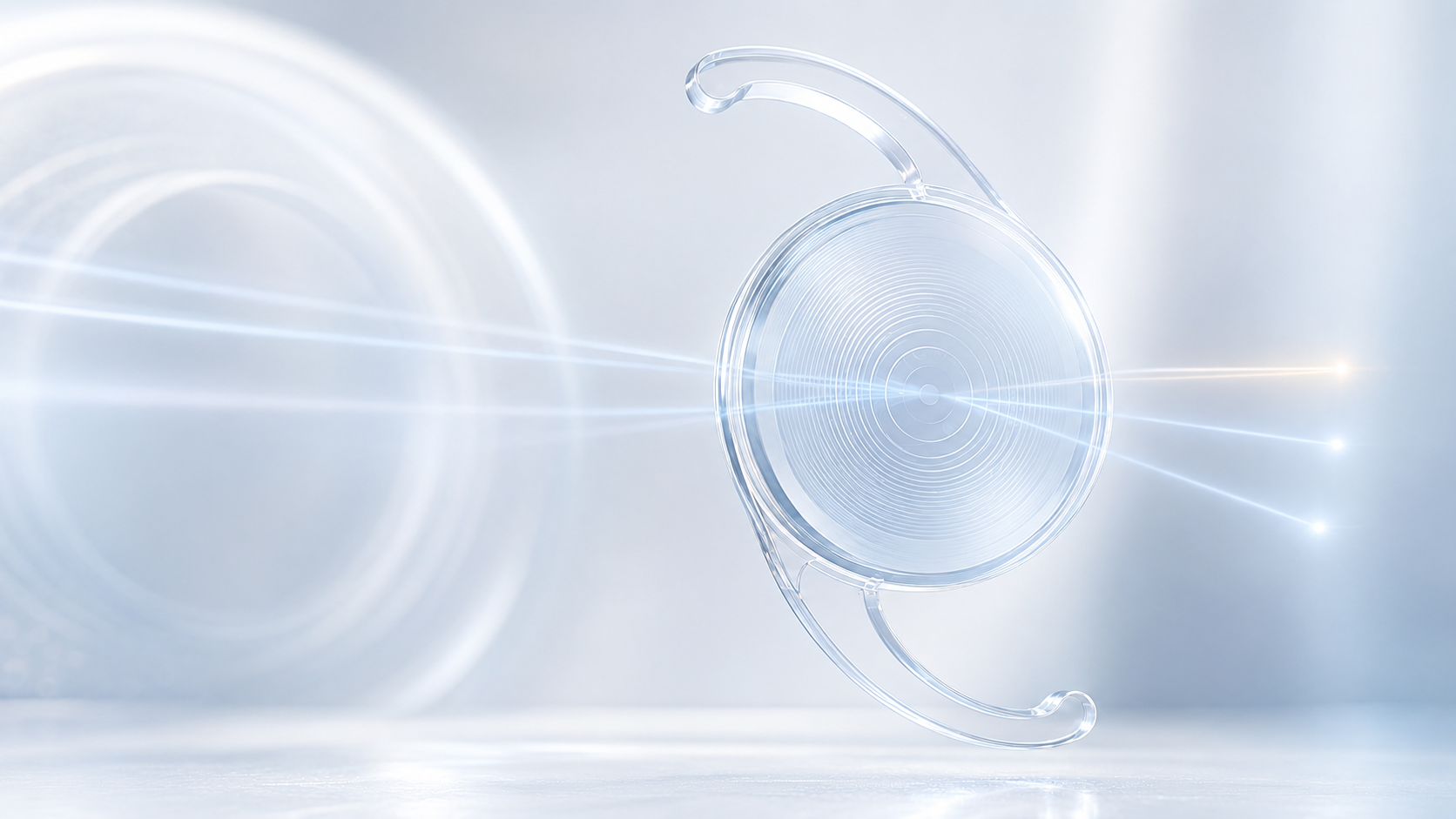
For suitable patients, trifocal implantable lenses can provide a long-term alternative to reading glasses and varifocals. During refractive lens exchange, the ageing natural lens is replaced with an advanced artificial intraocular lens. The procedure uses established techniques also used in modern cataract surgery.
Trifocal lenses are designed to provide three principal ranges of vision:
- Near vision for reading and close-up tasks
- Intermediate vision for computers, tablets and dashboards
- Distance vision for driving, television and outdoor activities
This can provide considerably greater independence from glasses, although no lens technology can guarantee complete freedom from them in every situation. Some patients may also notice optical effects such as halos or glare, particularly during the early stages of adaptation. A detailed consultation is therefore essential to establish whether trifocal lenses suit your eyes, lifestyle and expectations.
World-Leading ZEISS Trifocal Lens Experience
EuroEyes combines advanced ZEISS optical technology with one of the world’s most experienced trifocal lens surgery teams. ZEISS trifocal lenses are engineered to provide useful vision across near, intermediate and distance ranges. EuroEyes has been repeatedly recognised by ZEISS for performing more ZEISS trifocal lens implantations than any other clinic group worldwide, receiving the distinction for eight consecutive years.
This depth of experience is important because successful lens surgery involves much more than selecting an implant. Precise diagnostic measurements, careful lens calculations, accurate positioning and a treatment plan tailored to the individual patient all contribute to the quality of the final visual result.
Could You Live Without Varifocal Glasses?
If you are tired of searching for the correct part of your glasses, changing your posture at the computer or switching between different pairs throughout the day, trifocal lens treatment may provide another option. The first step is a comprehensive eye assessment. The EuroEyes London team can examine your eye health, measure your prescription and explain whether trifocal lenses or another form of vision correction would be most suitable for you.
Book your consultation at EuroEyes London and discover whether you could enjoy clear near, intermediate and distance vision with significantly less dependence on glasses.