UNDERSTANDING HOW YOUR EYES WORK TOGETHER
How Your Eyes Work Together Affects Lens Surgery
Perhaps you have always relied on one eye. Perhaps a childhood squint was corrected, but the other eye never became quite as sharp. What does that mean when you start considering cataract surgery or freedom from reading glasses?
Modern vision correction offers several ways to personalise your sight. Some treatments aim to give both eyes a similar focus. Others give each eye a slightly different role, helping you see across a wider range of distances. But there is an important question to answer before choosing a lens or treatment: how does your brain currently use the information from each eye? Having a dominant eye is normal. Having a lazy eye or a history of squint is something different. Understanding that difference helps your surgeon plan a result that supports the way you actually see.
Dominant Eye, Lazy Eye or Squint: Which Is Which?
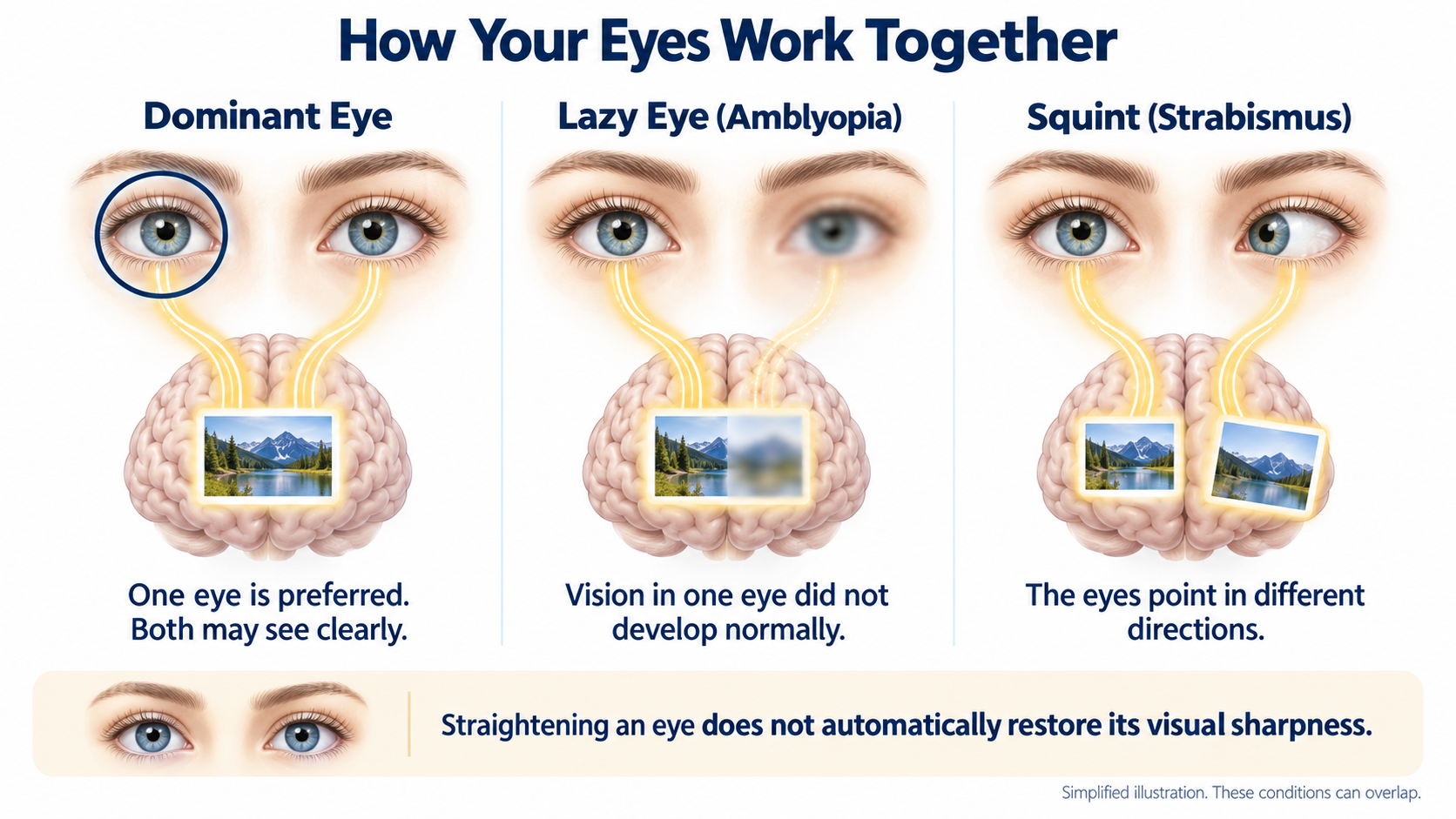
These terms are often used interchangeably, but they describe different features of vision.
PREFERENCE
A Dominant Eye
The eye your visual system tends to favour for certain tasks, such as aiming. Both eyes can still have excellent vision and work well together.
Dominance alone does not mean the other eye is weak.
VISUAL DEVELOPMENT
A Lazy Eye
Amblyopia develops when vision does not develop normally during childhood. One eye usually remains less sharp even with the best glasses prescription.
The eye can look perfectly straight.
ALIGNMENT
A Squint
Strabismus means the eyes are not consistently pointing in the same direction. An eye may turn inwards, outwards, upwards or downwards.
A squint can occur with or without amblyopia.
Does the Brain Really Ignore One Eye?
Usually, the brain combines information from both eyes into a single view. The small differences between the two images also help us judge depth. If a child’s eyes point in different directions, the images may conflict. The developing brain can suppress part of the information from the turned eye to avoid confusion or double vision. Over time, normal visual development in that eye may be affected. Amblyopia can also develop without a squint. For example, a large difference in prescription can leave one eye’s image consistently blurred during childhood. A cataract or another obstruction to clear vision during development can also cause it.
It is not always an “on or off” situation. A weaker eye may still contribute useful information. Suppression can vary, and some people retain peripheral cooperation between their eyes even when fine depth perception is limited.
“My Squint Was Corrected. Why Is That Eye Still Weaker?”
Squint surgery changes the position or action of the muscles that move the eye. Its purpose is to improve alignment. In selected patients, it can also help double vision and the way the eyes work together. However, straightening an eye does not automatically reverse amblyopia that developed during childhood. The eye may now point in the right direction while its best achievable vision remains reduced.
Three Separate Questions
Alignment: Are the eyes pointing in the same direction?
Clarity: How well can each eye see with its best prescription?
Cooperation: Can the brain comfortably use the two images together?
These questions explain why someone can have straight-looking eyes yet still rely heavily on one eye. It also explains why assessing appearance alone is not enough when planning vision correction.
Why Does This Matter for Cataract and Lens Surgery?
Cataract surgery removes a cloudy natural lens and usually replaces it with an artificial intraocular lens. The implant can improve clarity and correct some or much of the existing prescription. It does not directly treat the childhood developmental cause of amblyopia. Removing a cataract from an amblyopic eye may still improve its vision, but the result can be limited by the eye’s underlying visual potential. Your surgeon therefore needs to understand both the blur caused by the cataract and any weakness that existed long before it developed. Old prescriptions, previous vision measurements and details of childhood treatment can be useful.
Your Focusing Options, Explained Simply
These are discussion points for an assessment, rather than a way to select your own treatment. The degree of amblyopia, any suppression and the stability of eye alignment all matter.
A SIMILAR TARGET IN BOTH EYES
Distance Focus With Reading Glasses
Monofocal implants can be selected to target distance vision in both eyes. Reading glasses then provide additional help for near work.
Why discuss it? This avoids deliberately asking the eyes to work at substantially different focal distances. It may be appropriate when binocular vision is fragile, although equal focusing targets do not guarantee equal visual sharpness.
DIFFERENT FOCUSING TARGETS
Monovision or Mini-Monovision
One eye is targeted more towards distance and the other towards a closer range. Mini-monovision uses a smaller difference between the eyes.
What needs checking? The closer-focused eye must provide useful vision, and the brain must tolerate the difference. A history of squint, suppression or amblyopia can make this strategy unsuitable or require particular caution.
A WIDER RANGE OF FOCUS
EDOF, Multifocal or Trifocal Lenses
These lens designs extend the range of vision in different ways. EDOF lenses commonly prioritise distance and intermediate vision, while trifocal lenses also provide a near focal range.
What needs checking? Reduced visual potential and abnormal binocular function can affect the benefit. Contrast, glare and halos also need discussion. These implants do not bypass suppression or cure amblyopia.
COMPLEMENTARY LENS DESIGNS
A Mixed Lens Strategy
Selected patients may receive different lens designs in each eye to balance visual range and optical quality. This is different from simply choosing different prescription targets.
What needs checking? The combined result depends on how each eye contributes. Giving the weaker eye a lens designed for reading will not necessarily provide useful reading vision if that eye is significantly amblyopic or suppressed.
Astigmatism correction is another part of the plan. A toric lens may help suitable patients with regular corneal astigmatism, but correcting that optical blur does not remove an underlying developmental limitation.
What About PRESBYOND® Laser Blended Vision?
PRESBYOND® uses laser treatment to reshape the cornea while retaining the natural lens. It combines an extended depth of focus with a controlled difference in focus between the eyes. It is a different approach from mixing intraocular lens implants. Nevertheless, the ability to tolerate the proposed balance between the eyes remains important. Having a dominant eye is expected. Having significant amblyopia, suppression or a history of squint requires a more detailed assessment. A treatment that relies on useful contributions from both eyes cannot be assumed to work in the same way when one eye contributes very little.
Could Changing the Prescription Bring Back Double Vision?
In some people with a previous squint or childhood suppression, a substantial change in the balance of vision can disturb an arrangement that has been stable for years. For example, changing which eye the brain uses to fix on an object can occasionally uncover double vision. This is one reason to tell your surgeon about childhood patching, squint surgery or prism glasses, even if the problem seems long resolved. A contact-lens trial may help assess a proposed monovision target when practical. It cannot perfectly reproduce every surgical result or guarantee long-term tolerance.
What Should Be Checked Before Choosing Treatment?
- Each eye’s best-corrected vision: how clearly it sees with the most accurate prescription.
- Alignment and eye movements: including any hidden or intermittent deviation.
- Binocular function: whether the eyes combine images, suppress information or provide depth perception.
- Eye health: the cornea, cataract, retina and optic nerve.
- Your history and priorities: previous treatment, prism use, driving, reading and your reliance on the stronger eye.
An orthoptist, a specialist in eye alignment and binocular vision, may contribute to this assessment. The findings can influence the implant choice, focusing target and order in which eyes are treated.
Four Common Questions
Can cataract surgery help a lazy eye?
It may improve blur caused by a cataract, even when amblyopia is also present. However, it should not be presented as a cure for longstanding amblyopia. Your surgeon will discuss the likely improvement and any uncertainty about the eye’s visual potential.
Does a stronger left eye mean my right eye is lazy?
No. Dominance, prescription differences and eye disease can all affect the balance between your eyes. Amblyopia is diagnosed from the examination and developmental history, not from dominance alone.
Can the weaker eye simply be set for reading?
Only if it has sufficient useful vision and the overall arrangement is tolerable. A near-focused prescription cannot make a significantly amblyopic or suppressed eye perform like a normally developed eye.
Should I mention squint surgery from decades ago?
Yes. An old squint can remain relevant even when the eyes now appear straight. Bring any available details of surgery, patching, prism glasses or previous double vision to your consultation.
A new change needs attention. New weakness, a new eye turn or new double vision should not be assumed to be an old lazy eye. Seek urgent assessment for sudden double vision or sudden loss of vision.
A Plan for the Way You See
If you have a stronger eye, a childhood lazy eye or previous squint surgery, explain this when arranging your EuroEyes London consultation. Understanding that history helps the clinical team assess your options and discuss realistic expectations.
Further reading:
This article provides general information. Treatment suitability, risks and expected results require an individual clinical assessment. Surgery cannot guarantee freedom from glasses or normal binocular vision.