Quick Answer
Refractive lens exchange and cataract surgery use the same procedure, removing the natural lens and replacing it with an artificial one, but they are performed for different reasons. Cataract surgery treats a cloudy lens, while refractive lens exchange is done earlier to improve vision before cataracts develop.
It’s one of those questions that sounds simple, but usually comes with a bit of hesitation behind it.
“Is this the same surgery… or something different?”
The honest answer is this: yes, the procedure is almost identical, but the reason for doing it is completely different.
And that difference matters more than most people realise.
Same Procedure, Different Starting Point
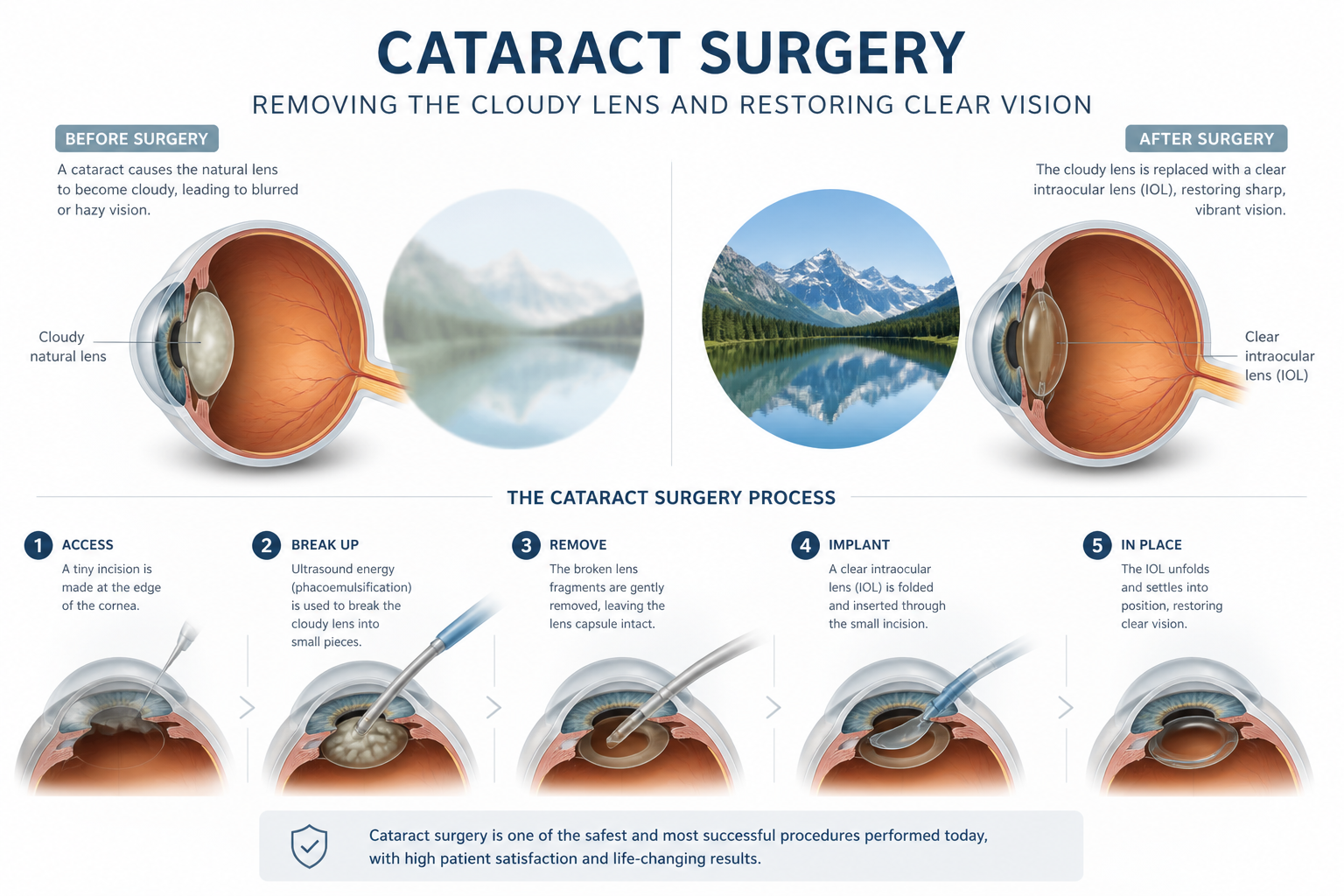
Both refractive lens exchange (RLE) and cataract surgery involve removing the natural lens of the eye and replacing it with an artificial intraocular lens.
From a surgical point of view, the steps are essentially the same. The techniques, the equipment, even the lenses used can be very similar.
But the patient sitting in the chair is usually at a very different stage.
Cataract surgery is performed because the natural lens has become cloudy. Vision is already affected, sometimes significantly, and the goal is to restore clarity.
Refractive lens exchange is done before that point. The lens is still clear, but vision is no longer working as well as it used to, often due to presbyopia or long-standing refractive error.
So while the surgery looks the same on paper, the intention behind it is quite different.
Why That Difference Matters
With cataract surgery, the decision is usually straightforward. The lens has deteriorated, and replacing it is the only way to restore vision.
With refractive lens exchange, it’s more of a choice.
Patients are often exploring options because they’re tired of reading glasses, struggling with multiple prescriptions, or noticing that their vision is becoming less predictable.
It becomes less about fixing a problem, and more about improving how you experience your vision day to day.
A Question Patients Often Ask
“Am I too early for cataract surgery, but too late for laser?”
That’s usually where RLE comes into the conversation.
Laser eye surgery works by reshaping the cornea, but it doesn’t address changes in the natural lens. Once presbyopia starts, usually in your 40s, the issue isn’t just how light enters the eye, it’s how the lens focuses it.
RLE steps in at that point.
It replaces the ageing lens entirely, which means it can correct distance, intermediate, and near vision in a way laser alone can’t.
What About the Lenses Used?
This is where things overlap even more.
Both cataract surgery and refractive lens exchange use intraocular lenses. These can be monofocal, multifocal, or trifocal depending on what the patient needs.
In fact, many of the lenses used in refractive lens exchange are the same premium lenses used in modern cataract surgery.
The difference is timing.
In cataract surgery, you’re replacing something that’s no longer working.
In RLE, you’re choosing to upgrade before that point.
A More Practical Way to Think About It
If we strip away the terminology, it becomes easier to understand.
Cataract surgery is reactive.
Refractive lens exchange is proactive.
One restores vision that has been lost.
The other improves vision before it deteriorates further.
Same tools. Same procedure. Different reason for being there.
Related Questions Patients Ask
Is refractive lens exchange permanent?
Yes. Once the natural lens is replaced, it cannot grow back. The artificial lens is designed to last for decades and does not degrade over time.
Will I still get cataracts after RLE?
No. Cataracts form in the natural lens. Once that lens is removed, cataracts cannot develop.
Is RLE safer than cataract surgery?
The risk profile is very similar because the procedure itself is the same. The key difference is patient selection. RLE is performed in otherwise healthy eyes, so planning and precision become even more important.
Why not just wait for cataracts?
Some patients do. Others prefer not to wait for their vision to deteriorate further. If you’re already relying heavily on glasses or noticing consistent changes, RLE allows you to address it earlier.
Can RLE replace laser eye surgery?
In certain cases, yes. Particularly for patients over 45 or those with presbyopia, RLE can provide a more complete solution than laser alone.
From My Perspective in Our London Clinic
Most patients don’t walk into our London clinic asking for refractive lens exchange by name.
They come in because something isn’t working anymore.
I remember one patient in his late 40s, a consultant who spent most of his day moving between screens and meetings. He told me, “I’ve got three pairs of glasses now and none of them seem to do everything I need.” That’s usually where the conversation starts, not with surgery, but with frustration.
Another patient, a keen driver, mentioned that night driving had become uncomfortable. Not dangerously bad, just inconsistent enough that he noticed it every time he got behind the wheel. He hadn’t considered lens surgery at all, he simply wanted to understand why his vision felt different depending on the situation.
And that’s often the pattern.
Reading becomes harder. Glasses become a constant. Vision starts to feel unreliable rather than just “slightly off”.
Once we assess the eye properly, everything tends to settle quite quickly. The conversation shifts from uncertainty to clarity. It’s no longer about choosing between two procedures, it’s about understanding where the eye is now, and what will provide the most stable result over the next 10 or 20 years.
In many cases, patients realise they’re not deciding between cataract surgery and refractive lens exchange as two separate things. They’re simply deciding whether to act now, while the lens is still clear, or wait until it changes naturally.
That moment of understanding is usually when things click.
A Technical Thought
Refractive lens exchange and cataract surgery are, technically, the same procedure. But for the patient, they represent two very different moments.
One is about restoring what has been lost. The other is about deciding not to wait for that loss to happen. And for many people, that decision is where everything changes.