What to Expect Day-by-Day, Week-by-Week, and Months Later
One of the most common questions patients ask is not about the procedure itself, but about what comes after. How quickly will I see clearly? When can I drive again? Will my eyes feel normal straight away?
Laser eye surgery has advanced significantly, particularly with treatments such as SMILE® Pro and modern LASIK, but recovery is still a journey. Understanding that journey properly helps patients feel confident, prepared, and realistic about their results. At EuroEyes London, we guide patients not just through surgery, but through every stage of recovery. What follows is a clear, experience-led view of what life looks like after laser eye surgery, from the first few hours through to long-term vision.
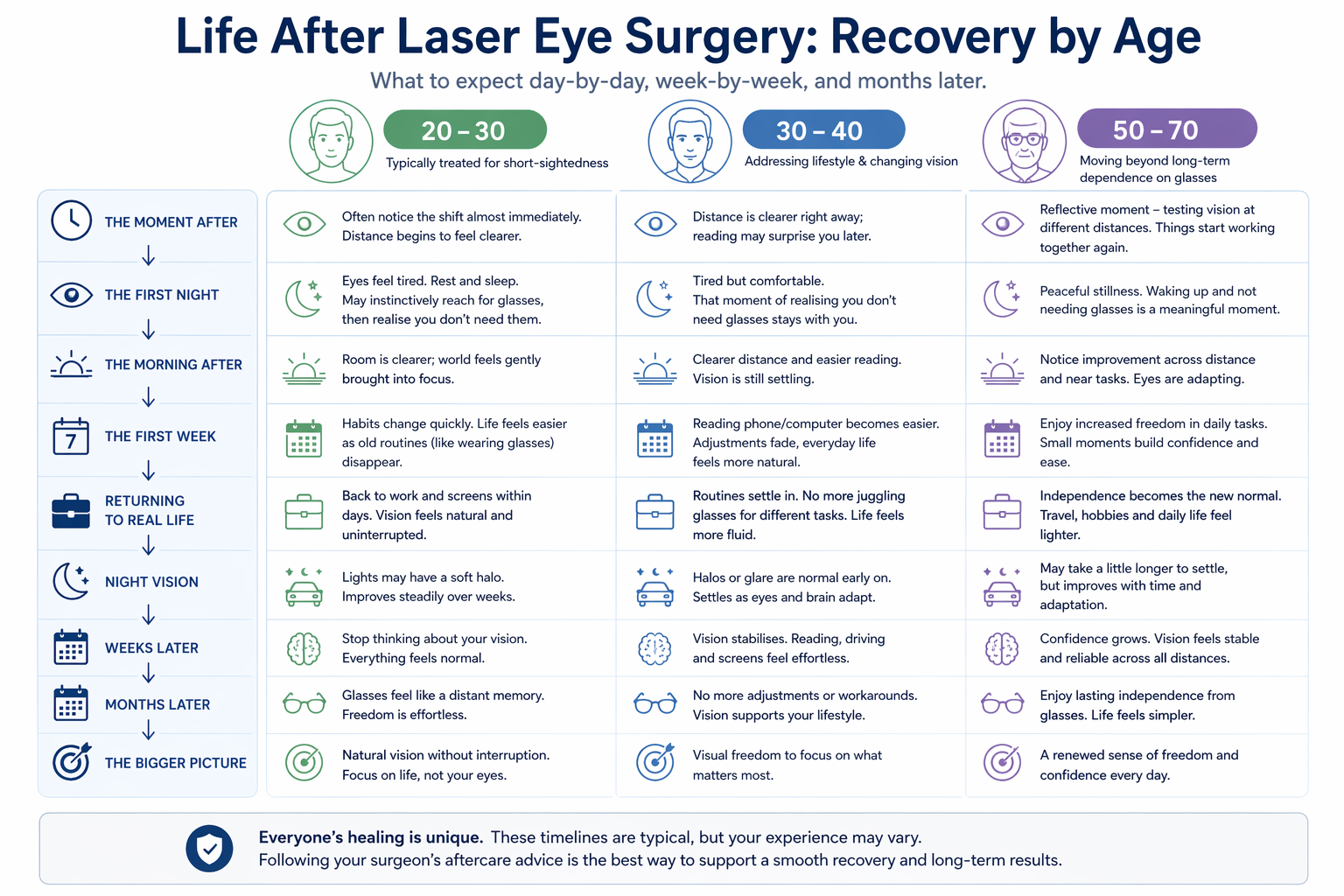
The Moment After
The procedure itself is over before most people have time to process it.
You’re guided out of the room, vision slightly hazy, lights a little brighter than usual. There’s a quiet moment where nothing dramatic happens, no instant cinematic clarity, just a subtle awareness that something has changed.
For many patients, the first real thought isn’t “I can see perfectly”, but rather:
“This feels different.”
And that’s exactly what it is. Not a switch. A transition.
But that transition doesn’t feel the same for everyone.
A patient in their late twenties, typically treated for short-sightedness, often notices the shift almost immediately. One described walking out and looking across the street, realising they could read a sign they hadn’t clearly seen in years. Not perfectly sharp yet, but enough to stop and take it in. For them, it felt like distance had quietly returned.
For someone in their early forties, where reading vision has started to change, the experience can be more layered. One patient explained that distance felt clearer straight away, but what surprised them most was picking up their phone later that evening and being able to read without instinctively adjusting the distance. It wasn’t dramatic, just unexpectedly easy.
For patients in their fifties, particularly those moving away from long-term dependence on glasses, the moment can feel more reflective. One described sitting at home that evening, looking across the room, then down at a book, then back again, almost testing it without meaning to. Not searching for perfection, just noticing that things were working together in a way they hadn’t for years.
Different ages, different eyes, different starting points. But the same underlying feeling.
Something has shifted! And it’s only just beginning.
The First Night
That first evening is often underestimated.
Your eyes feel tired, not painful, just as if they’ve done a full day’s work in a short space of time. Most patients go home, close their eyes, and drift in and out of sleep. There’s a stillness to it.
When you wake up a few hours later, you might instinctively reach for your glasses.
Then realise you don’t need them.
That moment stays with people.
The Morning After
The next morning is where things begin to shift.
You open your eyes, and the room is there. Not perfectly crisp, not quite final, but clear enough to notice the difference. The ceiling, the edges of furniture, the light coming through the window, it all feels slightly sharper, slightly easier.
Some describe it as if the world has been gently brought into focus rather than snapped into place.
There can still be a softness to vision at this stage. A slight glow around lights. A sense that your eyes are still “settling in”.
That’s normal.
Because they are.
The First Week
This is where the real change begins, and it’s not always in the way people expect. It’s not a sudden shift in what you can see, but a gradual change in how you move through your day.
A few days after surgery, you find yourself settling back into normal routines. Making a coffee in the morning, checking your phone, moving around the house without thinking too much about it. Then, almost without realising, your hand reaches to the side of the table where your glasses would usually be. There’s a brief pause when they’re not there. Not confusion, just a quiet moment where old habits surface, and then fade just as quickly. You look up, carry on, and realise you didn’t need them.
As the week unfolds, these small moments begin to repeat themselves. You pick up your phone and instinctively adjust it, holding it slightly further away, the way you’ve done for years. But this time, you don’t need to. The text comes into focus without effort. You bring it back to a natural distance, read it comfortably, and move on without giving it much thought. It’s subtle, but it stays with you.
What patients often notice during this stage is not perfection, but ease. The constant adjustments that once felt normal, shifting your posture, repositioning screens, relying on glasses for certain tasks, begin to disappear. Everyday actions feel more fluid, less interrupted. You’re no longer planning around your vision or compensating for it. Instead, things start to work in the background, the way they’re supposed to.
By the end of that first week, the difference becomes clearer. Not because everything feels dramatically new, but because it doesn’t. The effort has gone. The habits are fading. And without really noticing when it happened, you’ve stopped managing your sight altogether and simply started using it.
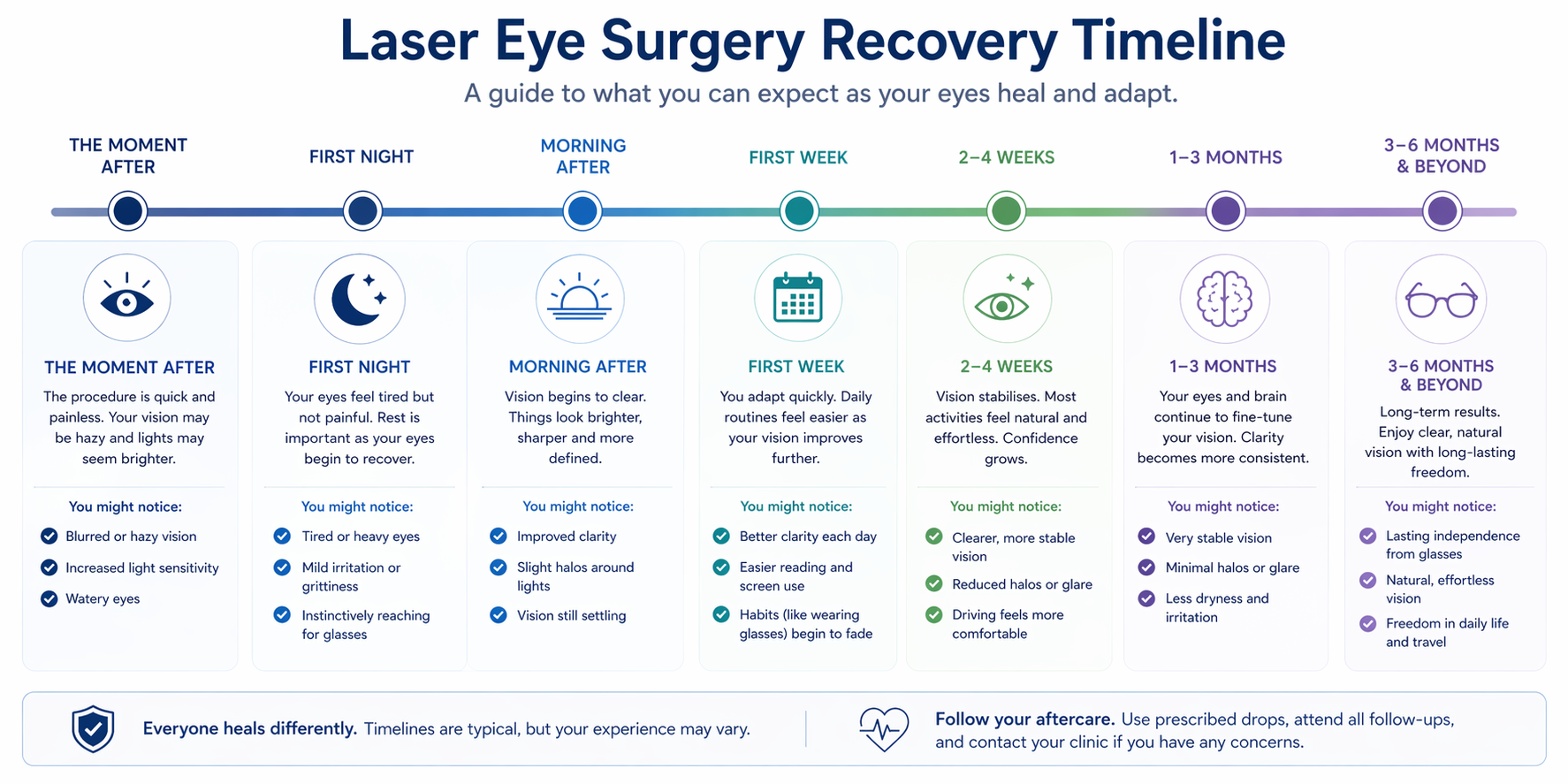
Returning to Real Life
Returning to work often happens sooner than most people expect. Within a few days, screens, emails, and daily routines begin to settle back into place, and on the surface, everything feels familiar. But beneath that familiarity, something has shifted in a way that’s easy to overlook at first.
You’re no longer adjusting your position to bring things into focus or leaning in slightly to read small text. The quiet interruptions that once shaped your working day, whether it was dealing with dry contact lenses or taking them out halfway through, simply aren’t there anymore. The process of seeing becomes less of an effort and more of a background function.
This carries through into the rest of the day. Stepping outside, you begin to notice how natural everything feels. Depth and distance seem more balanced, movement easier to track, as if your vision is working with you rather than needing to be managed. It’s not a dramatic shift that demands attention, but something more subtle.
Over time, that subtlety becomes the defining feature. Not a single moment of change, but a continuous sense of ease that stays with you throughout the day.
It’s not dramatic. It’s quiet. But it’s constant.
Night Vision and the Reality of Healing
It’s important to speak honestly about this part, because it’s often where expectations need to be grounded.
In the early stages after surgery, night vision can take a little longer to feel completely natural. Patients sometimes notice that lights appear brighter than expected, particularly when driving. There can be a soft halo or glow around headlights or street lamps, not overwhelming, but enough to be noticeable if you’re paying attention to it.
This isn’t unusual, and more importantly, it isn’t a sign that something is wrong. It’s part of the eye and brain adjusting to a new way of processing light. For years, your vision has worked within certain limits, often shaped by glasses or contact lenses. After surgery, those limits are removed, and the visual system needs time to recalibrate.
Modern techniques have significantly reduced these effects compared to earlier generations of laser eye surgery, but the adaptation phase still exists. Over the following weeks, most patients find that these visual disturbances soften and gradually fade, becoming less noticeable as the brain learns to interpret light more efficiently again.
What matters here is perspective. This stage is not a flaw in the result, but a natural part of the transition. Given time, clarity becomes more consistent, and night vision settles into something that feels stable and reliable.
Weeks Later
There is a point, usually a few weeks after the procedure, where the experience changes in a way that is difficult to define at first. It’s not marked by a specific improvement in clarity or a sudden shift in vision, but by something much quieter.
You stop thinking about it.
The need to assess your vision disappears. You’re no longer checking whether things are clear enough, comparing it to how it used to be, or paying attention to small fluctuations throughout the day. The awareness fades, and in its place comes a sense of normality.
Reading becomes something you do without preparation. Driving no longer carries that subtle layer of focus or caution. Even travelling feels lighter, not because of a dramatic change, but because the small dependencies have gone. There are no glasses to pack, no lenses to manage, no solutions to remember.
It’s in this stage that patients often realise the full impact of the procedure. Not because their vision feels extraordinary, but because it feels completely unremarkable in the best possible way.
Months Later
As time moves on, the idea of needing glasses begins to feel distant, almost unfamiliar.
Not in a way that stands out day to day, but in the same way any improvement gradually blends into your sense of normal. What once required thought, adjustment, and planning simply becomes automatic. You no longer notice your vision as something separate from everything else you’re doing.
It’s no longer something you manage.
It’s something you rely on, without hesitation, without awareness, without effort.
And that, ultimately, is what most patients are looking for. Not a perfect image in a clinical sense, but a level of clarity that supports life without interruption. A kind of visual freedom that doesn’t draw attention to itself, but quietly stays with you in everything you do.
Direct From The Surgeon
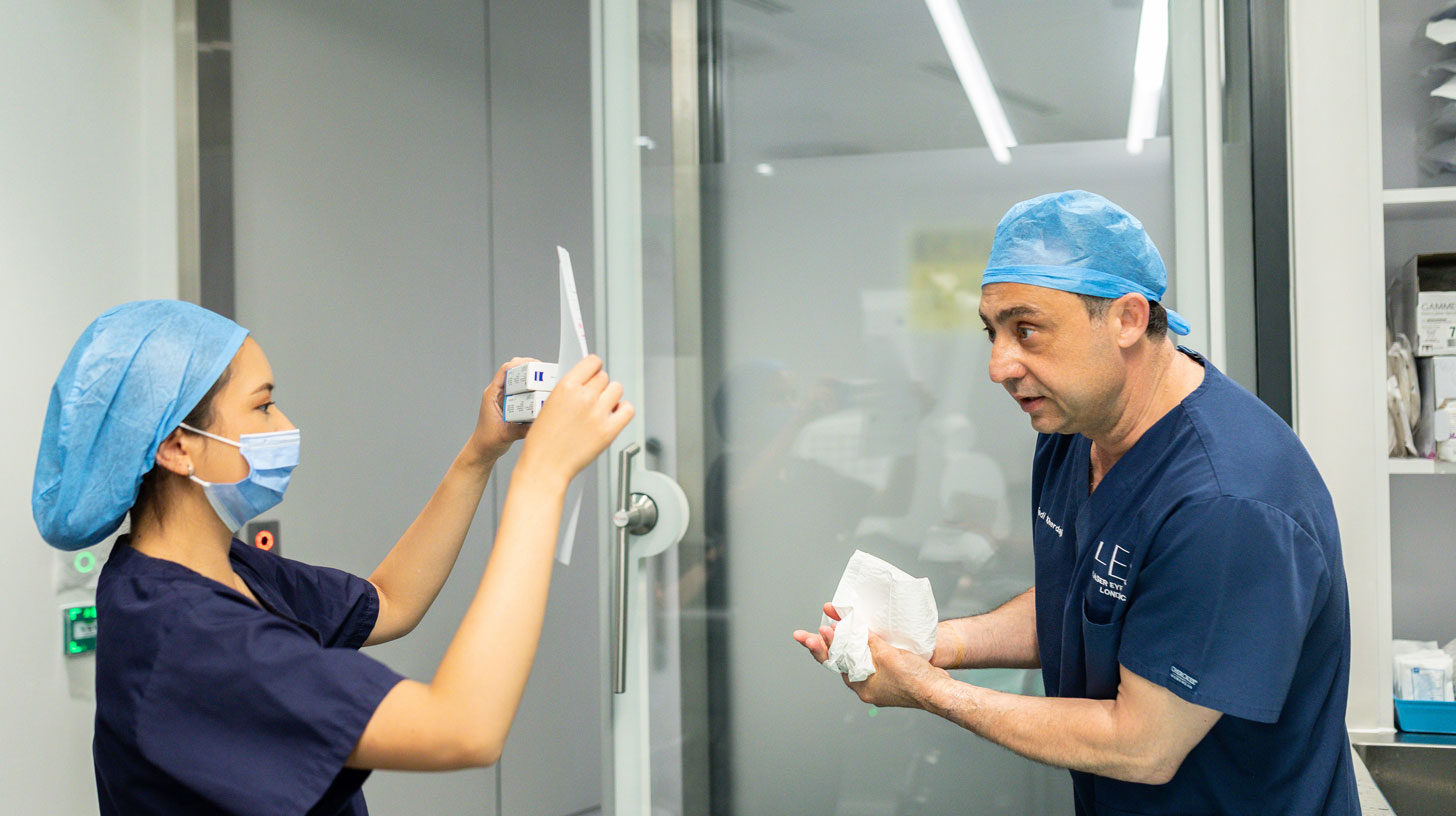
“As surgeons, we’re trained to focus on precision. The procedure itself is controlled, measured, and highly predictable. Every step is planned, every movement exact.
But what we see beyond that is something quite different.
Patients walk in having spent years managing their vision. Adjusting constantly, compensating without even realising it, building their day around what they can and can’t see comfortably. And then they leave with one less thing to think about.
That’s the real shift.
Laser eye surgery isn’t just about reading a line on a chart more clearly. It’s about how you move through your life afterwards. How natural things feel again, without interruption, without effort.”
Final Thought
The biggest misconception about laser eye surgery is that it’s about a single moment.
It isn’t.
It’s a series of small, quiet changes that build into something bigger. A gradual return to natural vision, without interruption.
And one day, without realising it, you stop noticing your eyes altogether.
Which is exactly how it should be.