It’s a small thing, but it can feel surprisingly unsettling. A few days or weeks after eye surgery, you notice a flicker in your eyelid. Not painful, not constant, just a light, repetitive twitch that seems to come and go without warning. For many patients, it raises an immediate question.
Is this normal?
The short answer is yes, in most cases it is. But like many post-operative experiences, the reasons behind it are worth understanding, particularly because they differ depending on the type of procedure you’ve had.
What Eye Twitching Actually Is
Eye twitching, medically known as myokymia, is a small, involuntary spasm of the eyelid muscles. It doesn’t affect your vision directly, and it isn’t happening inside the eye itself. It’s a surface-level response, usually linked to nerve sensitivity, fatigue, or irritation.
After surgery, the eye and surrounding tissues are in a heightened state of awareness. Nerves are adjusting, the tear film is stabilising, and the brain is recalibrating how it processes visual input. In that environment, small muscle responses like twitching can appear more easily.

Why It Happens After Surgery
Most of the time, eye twitching isn’t caused by the procedure itself, but by what the eye is going through afterwards.
Dryness is one of the most common triggers. When the surface of the eye isn’t fully lubricated, it creates low-level irritation. You may not consciously feel it, but the surrounding muscles respond.
Fatigue also plays a role. After surgery, patients tend to focus more, whether on screens or simply adjusting to new vision. That increased use can lead to muscle tension around the eye.
Then there’s the neurological element. The eye has been through a controlled procedure, and while healing is smooth, the nerves are still settling. That temporary sensitivity can manifest as small, repetitive movements.
How It Differs by Procedure
Laser Eye Surgery (SMILE® Pro, LASIK, PRK)
With laser procedures, twitching is most commonly linked to surface healing and dryness.
SMILE® Pro tends to preserve more of the corneal structure, which often means less dryness overall. When twitching does occur, it is usually mild and short-lived.
LASIK patients may notice it slightly more in the early stages, as the corneal flap and surface nerves recover. It’s rarely anything more than a temporary response.
PRK and LASEK involve surface healing, so the eye can feel more sensitive in the first couple of weeks. During this period, twitching can appear alongside dryness or light sensitivity, but typically settles as the surface stabilises.
Timeframe:
Usually appears within the first week and fades over 2-4 weeks.
Хирургия катаракты
After cataract surgery, the eye itself has been entered and the natural lens replaced, but the surface still plays a key role in recovery. Twitching here is often linked to post-operative drops, dryness, or simply the eye adapting to clearer vision. Patients sometimes blink more frequently in the early stages, which can contribute to muscle fatigue.
It’s also not uncommon for patients to become more aware of their eyes after surgery, noticing sensations that would have previously gone unnoticed.
Timeframe:
Typically mild and resolves within a few weeks.
Lens Replacement (RLE / Premium Lens Surgery)
Lens replacement procedures, particularly with trifocal or EDOF lenses, can introduce a period of visual adaptation.
While the surgery itself doesn’t directly cause twitching, the adjustment phase can. Patients may focus more intently as their brain learns to interpret new visual ranges, especially in the first few weeks.
This increased visual engagement, combined with dryness or light sensitivity, can contribute to occasional eyelid twitching.
Timeframe:
Often appears intermittently in the first few weeks and settles as adaptation completes.
When It’s Completely Normal
In most cases, eye twitching after surgery is:
- Mild and intermittent
- More noticeable when tired or using screens
- Not affecting vision
- Gradually improving over time
Many patients find it comes and goes, often disappearing without any specific treatment.
When to Pay Attention
While rare, it’s worth speaking to your clinic if:
- The twitching is constant or worsening
- It spreads beyond the eyelid
- It’s accompanied by pain, redness, or vision changes
- It persists beyond several weeks without improvement
These situations are uncommon, but checking in provides reassurance.
What Helps It Settle
Most of the time, the solution is simple.
Keeping the eyes well lubricated reduces surface irritation.
Getting proper rest allows the muscles to relax.
Reducing screen strain, especially in the early weeks, helps prevent fatigue-related twitching.
Often, no direct treatment is needed at all.
External Eye Itching Factors
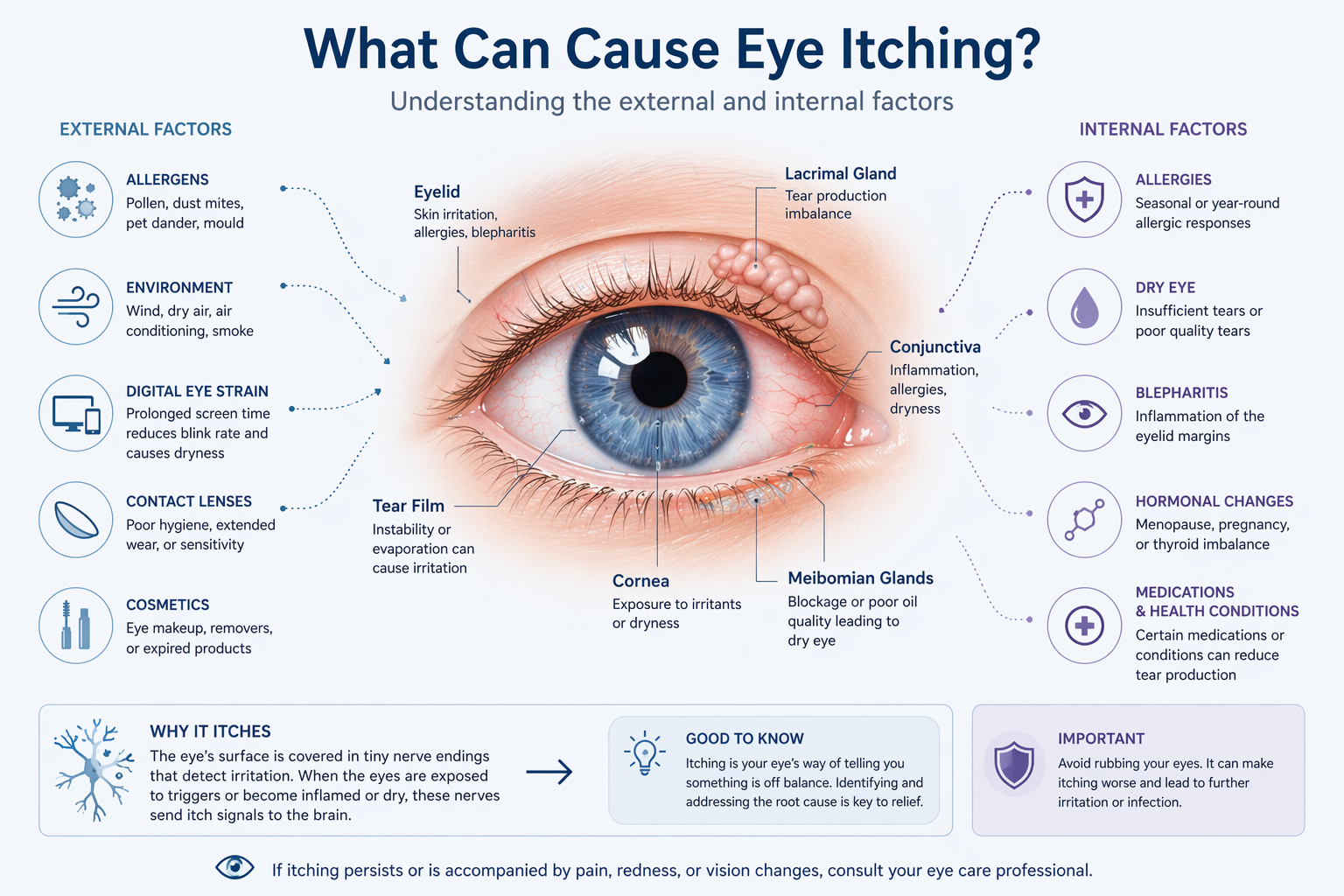
Eye itching is often caused by external factors rather than the internal healing process seen after surgery. Environmental triggers such as pollen, dust, wind, air conditioning, and smoke can all irritate the surface of the eye, especially when it is already sensitive. Everyday habits also play a role, prolonged screen use can reduce blink rate, leading to dryness and irritation, while cosmetics, skincare products, or contact lenses may introduce particles or allergens to the eye area. Unlike twitching, which is typically linked to muscle or nerve response, itching is more commonly a surface-level reaction. Recognising these external triggers can help patients understand the difference and take simple steps to reduce irritation during recovery.
Direct From Our Surgeon
“As surgeons, we see eye twitching quite regularly after procedures, and in the vast majority of cases, it’s nothing to be concerned about. The eye is going through a period of adjustment. Vision has changed, the surface is healing, and the nerves are settling. Small muscle responses like twitching are simply part of that process.
What’s important is that it resolves, and in most cases, it does so naturally as the eye returns to balance.”

From EuroEyes
Eye twitching after surgery can feel unexpected, but it is usually a temporary and harmless part of recovery. It reflects the eye adapting, healing, and recalibrating, rather than anything going wrong. For most patients, it fades in the background just as quietly as it appeared, leaving behind what they were aiming for all along.
Clear, comfortable vision without distraction.