For most people considering laser eye surgery, the procedure itself is only part of the decision. The bigger question is what happens afterwards. How long does it take to recover, when does vision become clear again, and how quickly can you return to normal life?
The reality is that recovery from laser eye surgery is often much faster than people expect. Modern techniques such as LASIK and SMILE Pro are designed to minimise disruption to the eye, allowing patients to return to daily activities within a very short period of time. However, understanding the healing process properly helps set realistic expectations and ensures the best possible outcome.
Сроки восстановления после лазерной хирургии глаза
| Timeframe | What to Expect | What You Can Do |
|---|---|---|
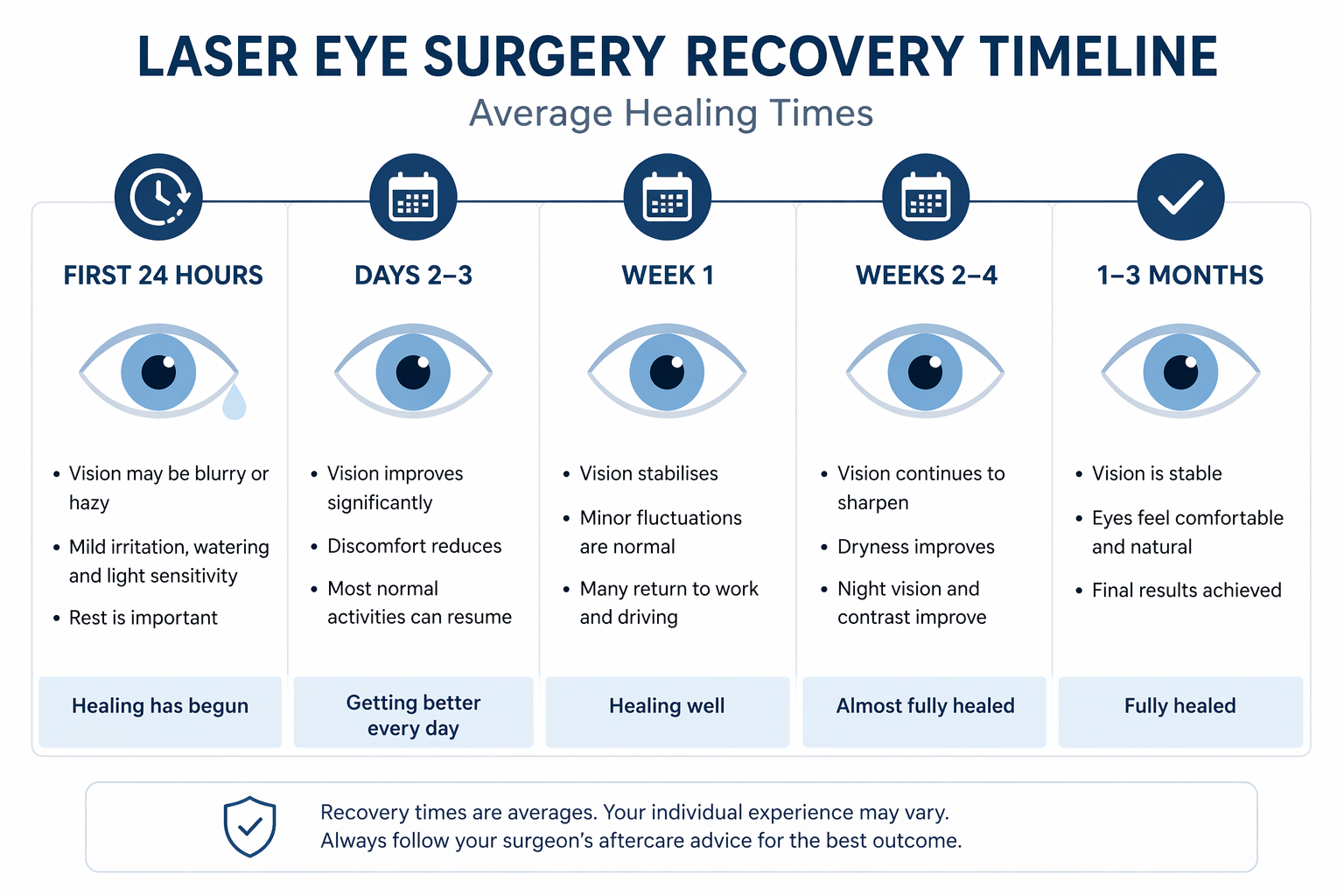
| First 24 Hours | Vision may feel hazy, with mild irritation or watering. Light sensitivity is common. | Rest your eyes, keep them closed where possible, use prescribed eye drops, avoid screens. |
| Day 2–3 | Vision becomes clearer, discomfort reduces significantly. | Return to light activities, short screen use, attend follow-up appointment. |
| Week 1 | Vision stabilises with minor fluctuations, dryness may occur. | Return to work, drive if vision meets legal standard, continue eye drops. |
| Недели 2-4 | Improved clarity, reduced dryness, night vision begins to settle. | Resume most normal activities, avoid swimming and eye makeup if advised. |
| 1–3 Months | Vision fully stabilises, final results become clear. | Enjoy full visual outcome, attend any final check-ups if required. |
Recovery times can vary slightly depending on the procedure, such as LASIK or SMILE Pro, and individual healing response. Your surgeon will provide personalised guidance based on your eyes and lifestyle.
How Long Does Laser Eye Surgery Recovery Take?
One of the most common questions patients ask at EuroEyes UK is how long recovery actually takes. The answer depends slightly on the procedure, but in general, recovery follows a predictable pattern.
Most patients notice an improvement in their vision within the first 24 hours. For LASIK, many people are able to return to work within one to two days. SMILE Pro can offer an equally fast recovery, often with less initial dryness.
That said, while vision improves quickly, the eye continues to heal beneath the surface for several weeks. Subtle changes in clarity, contrast, and focus are all part of the normal healing process.
The First 24 Hours After LASIK
The first day is usually the most noticeable stage of recovery. Vision may feel slightly hazy, and the eyes can feel sensitive or watery. Some patients describe a mild scratchy sensation, similar to having an eyelash in the eye.
This settles quickly. By the following day, most people are surprised by how comfortable their eyes feel and how much their vision has already improved.
Rest is important during this period, and patients are advised to keep their eyes closed as much as possible for the first few hours after treatment.
LASIK Recovery Time, Week 1
During the first week, vision continues to stabilise. You may notice small fluctuations, particularly in different lighting conditions. This is completely normal and part of the healing process.
Most patients can:
- Return to work within 2 to 3 days
- Drive again once vision meets legal standards
- Resume light daily activities almost immediately
However, it is important to follow aftercare advice carefully, particularly when using eye drops and avoiding unnecessary strain.
What to Avoid After Laser Eye Surgery
A smooth recovery is not just about time, it is about how you treat your eyes in the early stages.
- Rubbing your eyes should be avoided, even if they feel slightly irritated, as this can interfere with healing
- Swimming pools, hot tubs and saunas should be avoided for at least a couple of weeks due to infection risk
- Eye makeup should be paused during the initial healing period to prevent irritation
- Dusty or smoky environments should be avoided as they can increase dryness and discomfort
- Screens can be used, but regular breaks are recommended to support healing
When Can You Drive After Laser Eye Surgery?
Driving after laser eye surgery is a major concern for many patients, especially those who rely on their car for work, school runs or everyday independence. In most cases, patients are able to drive again within a few days, but only once their vision meets the legal driving standard and their surgeon confirms that recovery is progressing safely.
A follow-up appointment is usually arranged shortly after treatment to check how the eyes are healing and how well vision is settling. Although many people notice clearer vision quickly, short-term fluctuations can still occur in the first couple of days.
For example, if treatment takes place on a Friday, it is often advisable to rest over the weekend and attend a follow-up before driving again on Monday, provided vision is clear and approved by the surgeon. Driving immediately after surgery or attempting longer journeys too soon is not recommended.
How Does LASIK Heal Over Time?
Even though vision improves quickly, full healing takes longer and continues over several weeks.
- Vision becomes progressively sharper and more consistent
- Night vision improves as halos and glare gradually reduce
- Dryness decreases as the eye restores its natural tear balance
- Focus stabilises, making daily tasks feel more natural again
By around three months, most patients reach their final visual outcome.
Laser Eye Surgery Recovery, Age, Health Factors and Possible Complications
| Категория | Typical Guidance | Recovery Overview | Possible Complications or Concerns | What to Do |
|---|---|---|---|---|
| Возрастной диапазон | Most laser eye surgery patients are typically aged between 20 and 60, provided their prescription is stable and the eyes are otherwise healthy. | Younger patients often notice fast visual recovery, while patients in their 40s and 50s may also need to consider age-related changes such as presbyopia. | Older patients may assume laser will solve every vision issue, when near vision changes may still need separate planning. | Have a full consultation to assess not only prescription, but also reading vision, lens health, and long-term suitability. |
| Стабильность рецепта | A stable prescription is usually important before treatment, particularly for younger adults whose eyes may still be changing. | Stable eyes tend to support more predictable healing and clearer long-term outcomes. | If the prescription is still changing, results may become less accurate over time, even if surgery itself is successful. | Wait until prescription measurements have remained stable, based on your surgeon’s advice and recent eye test history. |
| Здоровье роговицы | Corneal thickness, shape, and surface quality all influence which procedure is safest and most effective. | Healthy corneas usually support smoother healing after LASIK or SMILE Pro, while thinner corneas may be better suited to PRK or LASEK. | If the cornea is too thin or irregular, flap-based treatment may not be suitable and healing may need closer monitoring. | Follow the treatment option recommended after diagnostic scanning, rather than assuming one procedure suits everyone. |
| История сухого глаза | Patients with existing dry eye symptoms may still be suitable, but the treatment choice and aftercare plan may need adjusting. | Mild dryness is common early on, but modern treatments and lubricating drops usually help the eyes settle well. | Dryness can feel more noticeable in the first days or weeks, especially with heavy screen use, air conditioning, or poor tear quality. | Use lubricating drops exactly as advised, reduce unnecessary screen strain, and attend follow-up reviews if symptoms persist. |
| General Health Factors | Healing can be influenced by overall health, medication use, autoimmune conditions, and how well the eyes recover naturally. | Most healthy patients recover quickly, but some may need a slightly slower healing timeline depending on their individual profile. | Delayed healing, increased dryness, or more variable vision can occur if the body is slower to repair the eye surface. | Be open during consultation about medication, medical history, and any healing issues you have experienced in the past. |
| First 24 Hours | Vision may be hazy, watery, slightly scratchy, or sensitive to light immediately after treatment. | This is usually the most noticeable stage of recovery, and many patients already feel more comfortable by the next day. | Temporary discomfort, watering, glare, and mild blur are common and do not usually indicate a problem. | Rest with your eyes closed where possible, use prescribed drops, avoid rubbing the eyes, and arrange transport home. |
| First Week | Most patients return to work, light routines, and normal day-to-day activities within a few days. | Vision continues to sharpen, although small fluctuations in clarity and focus are still normal. | Dryness, minor visual fluctuation, light sensitivity, and temporary night glare can still occur. | Continue all aftercare exactly as advised, avoid swimming, avoid eye makeup, and do not ignore unusual pain or sudden vision change. |
| Weeks 2 to 4 | The eye continues healing beneath the surface, even when day-to-day vision already feels much better. | Most patients notice clearer, more stable vision and gradually less need for lubricating drops. | Some people still notice halos, glare, or dryness during this period, especially at night or on screens. | Stay consistent with follow-up care, protect the eyes from irritation, and mention any symptoms that feel persistent or unusual. |
| 1 to 3 Months | By this stage, the majority of patients have reached or are close to their final visual outcome. | Vision is typically more stable, more natural, and less prone to fluctuation than in the early healing phase. | Rarely, patients may still notice residual dryness, mild night-time symptoms, or the need for further review. | Attend final checks, report any unresolved concerns, and ask whether enhancement or further monitoring is appropriate if needed. |
| Driving After Surgery | Driving is only appropriate once vision meets the legal standard and your surgeon confirms recovery is progressing well. | Some patients are ready within a few days, but this should never be assumed without assessment. | Driving too early, especially at night, may be unsafe if glare, halos, or blur are still present. | Wait until your follow-up confirms it is safe to drive, and avoid night driving until vision feels fully comfortable. |
| Signs That Need Attention | Most recovery symptoms are mild and temporary, but some signs should always be taken seriously. | Normal healing should gradually improve, not suddenly worsen. | Severe pain, a sharp drop in vision, increasing redness, or discharge may require urgent review. | Contact your clinic immediately if symptoms feel significantly worse rather than better, or if something does not feel right. |
Recovery from laser eye surgery is usually smooth and far quicker than many patients expect, but age, eye health, corneal structure, dryness, and general health can all influence the experience. A thorough consultation and careful aftercare remain the best way to support a safe recovery and strong long-term result.
Why Modern Laser Eye Surgery Recovers So Quickly
Advances in laser technology are the reason recovery is now so fast and predictable. Procedures such as SMILE Pro use minimally invasive techniques that preserve more of the eye’s natural structure, reducing irritation and improving comfort during recovery.
At EuroEyes London, detailed diagnostics and personalised treatment planning also play a key role. By tailoring the procedure to each patient’s eye, surgeons can optimise both results and recovery time.
A Reassuring Final Thought

One of the most common misconceptions is how disruptive recovery from laser eye surgery will be. In reality, modern procedures are designed to be quick, precise and minimally invasive, allowing most patients to return to normal daily activities much sooner than expected.
While it is completely normal to feel apprehensive before treatment, patients are often surprised by how straightforward the experience feels once it begins. The procedure is carefully controlled, and recovery is supported with clear aftercare and follow-up guidance from the clinical team.
EuroEyes surgeons consistently emphasise that understanding the recovery process in advance helps build confidence. Knowing what to expect and how the eye heals allows patients to feel more relaxed and reassured throughout their journey.