Presbyopia is a natural, age-related change in focusing that usually becomes noticeable from your early to mid-40s. It is not a disease, but it can make reading and close work feel unexpectedly difficult.
Presbyopia is a completely natural part of ageing. It is not a condition that means something has “gone wrong” with your eyes. Instead, it is the point in life where the eyes gradually lose their ability to focus up close.
Most people first notice it in their early to mid-40s. Reading menus in low light becomes harder, phone text looks blurrier than it used to, and you may find yourself holding books or screens further away. People often joke that their arms are “getting longer”, although what is really happening is a change inside the eye itself.
How focusing works when we are younger
To see clearly up close, typically at a reading distance of around 30 to 40 centimetres, the eye needs to increase its focusing power by roughly +3 diopters. In younger eyes, this happens effortlessly.
Inside the eye sits the natural lens. When you look at something nearby, the lens becomes slightly more rounded, which increases its focusing strength. When you look into the distance, the lens flattens again. This process is called accommodation, and it happens automatically throughout the day.
In your 20s and 30s, the lens is soft and flexible. It adapts quickly, allowing you to move between phone, book, dashboard and horizon with no noticeable effort.
What changes after 40?
From around the age of 40, the natural lens slowly begins to stiffen. This is a gradual change in the lens material itself. As it becomes less flexible, it can no longer change shape enough to provide the full focusing power needed for near vision.
At first, the lens might only manage about +2 diopters instead of the +3 required for comfortable reading. That missing diopter can be enough to make close text appear slightly blurred, particularly in dim lighting or at the end of the day when the eyes are tired.
To compensate, many people instinctively move reading material further away, where less focusing power is needed. This often works for a while, but it is one of the earliest signs that presbyopia has begun.
At this stage, mild reading glasses or progressive lenses are commonly used to make up the difference, often starting around +1.0 diopter. Distance vision is usually still excellent, it is the close work that becomes the challenge.

A slow, predictable process
Presbyopia does not arrive overnight. It develops gradually over 10 to 15 years.
As the lens continues to stiffen, it loses more of its ability to accommodate. From the late 40s into the 50s, stronger reading or progressive glasses are often needed. By around 60 to 65, the natural lens has usually lost almost all of its flexibility, which means the full +3 diopters required for near vision must be corrected with glasses.
For many people, this means updating prescriptions regularly, juggling different pairs of glasses, or relying on progressive lenses for everyday life. Over time, the cumulative cost of eyewear, particularly high-quality progressive lenses, can become significant.
Presbyopia progression, typical near-vision correction by age
As the natural lens stiffens with age, reading or progressive glasses usually become stronger. This chart shows the typical increase in near correction through the 40s, 50s and early 60s.
Higher correction
Typical near-vision correction (reading/progressives)
Natural lens flexibility (declines with age)
Note: Prescriptions vary by individual, this is a general guide to help explain the trend.
Why glasses do not stop presbyopia progressing
It helps to know that glasses do not slow or stop presbyopia. They simply compensate for the focusing power the natural lens can no longer provide. The underlying ageing process continues regardless.
This is why prescriptions tend to increase over time until presbyopia stabilises later in life. In most cases, the eyes remain healthy, it is the mechanical flexibility of the lens that has changed.
A modern solution: Trifocal lens replacement
Advances in eye surgery have made it possible to address presbyopia at its source.
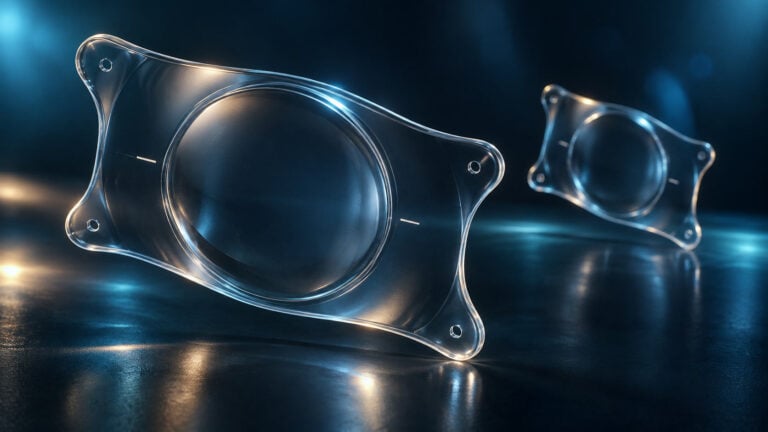
EuroEyes, in collaboration with Carl Zeiss, has developed a specialised trifocal intraocular lens designed to replace the ageing natural lens. Unlike the natural lens, this artificial lens does not need to change shape to focus.
Instead, its advanced optical design provides clear vision at distance, intermediate and near, at the same time. Because it does not rely on accommodation, the age-related stiffening that causes presbyopia is no longer a limiting factor.
Once implanted, the lens remains stable for life. Vision at all distances can stay consistent and does not decline in the way natural accommodation does. For many patients, this can mean long-term freedom from reading glasses and progressive lenses.

Seeing presbyopia for what it is
Presbyopia is not a failure of the eyes, it is a milestone. It marks a natural shift in how vision works as we age. Understanding the process helps people make informed choices, whether that means continuing with glasses or exploring modern lens-based solutions designed for long-term visual independence.