(White Paper)
Expert Insights from EuroEyes London
How leading eye clinics design confidence, safety and clarity before, during and long after surgery
Executive Summary
Vision correction has undergone a fundamental transformation over the past two decades. While glasses and contact lenses have provided effective external correction for generations, and laser eye surgery reshaped the cornea to improve focus, modern implantable lens technology has introduced a new paradigm: correcting vision from within the eye itself.
Implantable lenses allow surgeons to precisely control how light is focused onto the retina, independent of corneal limitations or tear film instability. Technologies such as Implantable Contact Lenses (ICL), trifocal intraocular lenses, and Light Adjustable Lenses now allow visual outcomes to be tailored with unprecedented accuracy and stability.
This white paper explores the evolution of implantable lens technology, its safety and long-term performance, patient suitability, and how modern intraocular optics are redefining expectations in vision correction.
Introduction
Moving Beyond Surface-Level Vision Correction
For most of modern history, vision correction has relied on external optical devices. Glasses and contact lenses compensate for refractive error by altering how light enters the eye. While effective, these approaches do not change the underlying optical system.
Laser eye surgery represented a major advancement by reshaping the cornea to improve focus. However, laser procedures are constrained by corneal thickness, structural safety limits, and long-term biomechanical considerations.
Implantable lenses represent a fundamentally different approach.
Rather than modifying the surface of the eye, implantable lenses introduce a precisely engineered optical element inside the eye, allowing direct control over the focal point of incoming light.
This shift from external compensation to internal optical optimisation represents one of the most important advances in ophthalmology.
Limitations of Traditional Vision Correction Methods
Glasses
Glasses remain one of the safest and most effective ways to correct refractive error, and for many patients they provide reliable visual clarity for everyday tasks. However, glasses correct vision from outside the eye, which introduces a physical and optical distance between the corrective lens and the eye’s natural visual system. This separation can affect how light enters the eye, particularly at the edges of the visual field.
As a result, patients often experience reduced peripheral clarity compared to natural vision or internal optical correction. Objects may appear slightly distorted toward the edges of the lens, and depth perception can feel less natural, particularly in higher prescriptions. Many patients describe subtle differences in spatial awareness, especially when navigating stairs, driving, or participating in fast-moving activities.
There is also the practical aspect of wearing glasses in daily life. Glasses can be affected by environmental conditions such as rain, temperature changes, and condensation. They require regular cleaning, adjustment, and replacement as prescriptions change. For active individuals, glasses can become restrictive during exercise, sports, or travel, and some patients feel constantly aware of their dependence on them.
Over time, this reliance becomes part of daily routine. While glasses provide effective optical correction, they do not change the eye’s internal focusing ability. Modern implantable lens technology offers an alternative approach by correcting vision from within the eye itself. This allows light to be focused naturally onto the retina without the external limitations of spectacle lenses, providing a more stable and integrated visual experience.
From a clinical perspective, this internal correction allows patients to experience vision that feels clearer, more consistent, and less dependent on external devices.

Contact Lenses
Contact lenses provide a more natural optical correction than glasses because they sit directly on the surface of the eye, allowing light to enter more centrally and reducing many of the distortions associated with spectacle lenses. For this reason, millions of patients rely on contact lenses successfully for many years. However, contact lenses function as a temporary optical surface, and their performance is closely linked to the stability of the tear film and the health of the cornea.
In real-world conditions, the tear film is constantly changing. Extended screen use, air conditioning, heating, and natural aging can all reduce tear stability. When this happens, contact lenses may no longer sit perfectly on a smooth optical surface, and patients often notice subtle fluctuations in clarity. Many describe moments where vision takes longer to focus, or where clarity varies throughout the day, particularly in the evening or after prolonged concentration.
Dryness is one of the most common long-term challenges. Because contact lenses sit directly on the cornea, they can reduce oxygen transmission and disrupt the natural tear film. Over time, this can lead to irritation, dryness, and reduced comfort, even in patients who previously tolerated lenses well. It is not uncommon for patients who have worn contact lenses comfortably for 10 or 15 years to find them increasingly difficult to tolerate later in life.
There is also the ongoing responsibility of daily handling and maintenance. Contact lenses must be inserted, removed, cleaned, and replaced regularly. This routine becomes part of everyday life, and while manageable, it represents a lifelong dependency on external optical correction.
From a clinical perspective, these limitations are not a failure of contact lenses themselves, but a reflection of their temporary nature. They correct vision from outside the eye and depend on surface conditions that naturally change over time. Implantable lens technology was developed to overcome these limitations by placing a stable, permanent optical correction inside the eye, where it is unaffected by tear film instability, dryness, or daily handling.
For many patients, this transition represents a shift from managing vision on a daily basis to experiencing consistent, stable clarity without ongoing maintenance.

Laser Eye Surgery
Laser eye surgery works by reshaping the cornea, the clear front surface of the eye, to improve how light is focused onto the retina. For many patients, this provides excellent visual outcomes. However, laser treatment depends entirely on the natural structure and thickness of the cornea, and there are safety limits to how much tissue can be safely reshaped.
For example, patients with higher prescriptions, such as −8.00 or −10.00 dioptres; often require more significant corneal reshaping. In these cases, removing too much tissue could weaken the structural integrity of the cornea. Similarly, patients with naturally thin corneas may not have sufficient thickness to safely perform laser correction, even with modern techniques. Others may have subtle irregularities in corneal shape, which can affect how predictably the laser treatment can improve focus.
Implantable lenses provide a solution in these situations because they do not rely on reshaping the cornea at all. Instead, the lens is placed inside the eye, where it works directly with the eye’s natural optical system. This allows us to correct higher prescriptions and more complex optical conditions safely, while preserving the natural corneal structure.
In clinical practice, this often allows patients who were previously told they were not suitable for laser eye surgery to achieve clear, stable vision using implantable lens technology.

Implantable Contact Lens (ICL): Precision Vision Correction Inside the Eye
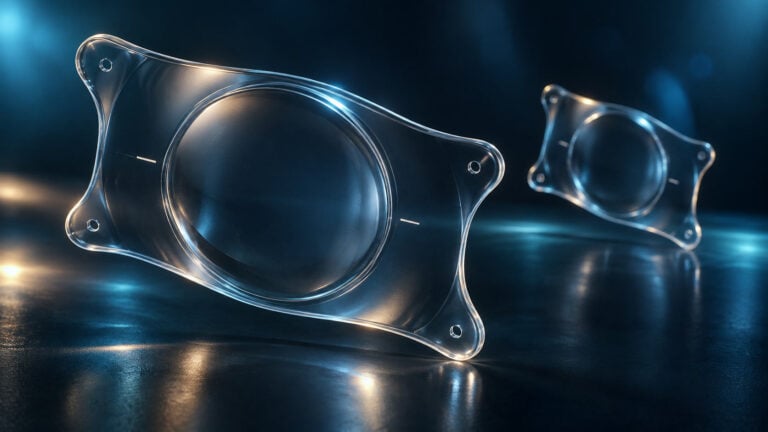
Implantable Contact Lenses are positioned behind the iris and in front of the natural lens. This location allows the implant to work in harmony with the eye’s natural optical system.
Unlike laser surgery, ICL does not remove tissue. Instead, it adds optical precision.
Key advantages include:
- Exceptional visual clarity
- Stability independent of tear film
- Preservation of corneal structure
- Long-term durability
Modern ICL lenses are made from highly biocompatible materials designed to remain safely inside the eye for decades.
Patients often experience immediate improvement in clarity and long-term visual stability.
Trifocal Lens Technology: Restoring Vision Across All Distances
As the natural lens ages, its ability to change focus declines. This condition, known as presbyopia, affects the majority of patients over 45.
Trifocal intraocular lenses address this limitation by providing multiple focal zones.
These lenses allow patients to see clearly at:
- Distance
- Intermediate range (screens, dashboards)
- Near distance (reading)
This restores functional visual independence without reliance on reading glasses.
Light Adjustable Lens: The First Truly Customisable Vision Correction
One of the most important recent advances is the Light Adjustable Lens.
Unlike traditional lenses, this technology allows surgeons to adjust the optical power of the lens after implantation.
This provides unprecedented control over the final visual outcome.
Once optimal clarity is achieved, the lens is permanently stabilised.
This removes one of the last remaining uncertainties in refractive surgery.
Safety and Longevity of Implantable Lens Technology
Modern implantable lenses are designed for permanent use.
The materials used are:
- Biocompatible
- Stable
- Resistant to degradation
Clinical experience and long-term studies demonstrate excellent safety profiles.
Implantable lenses do not wear out and typically remain effective for life.
Unlike contact lenses, they do not require daily maintenance.
Patient Suitability and Selection
Implantable lenses are suitable for a wide range of patients, particularly those with:
- Moderate to high refractive error
- Astigmatism
- Thin corneas
- Contact lens intolerance
Suitability is determined through detailed diagnostic imaging and clinical assessment.
Each patient’s anatomy and visual goals guide lens selection.
Real-World Impact: Improving Quality of Life
The impact of implantable lens technology extends far beyond correcting a prescription on paper. By improving how light is focused within the eye itself, this technology can enhance the overall quality and consistency of vision in ways that external correction cannot fully replicate. Patients frequently describe changes that affect not just what they see, but how confidently and comfortably they experience daily life.
Visual clarity
Patients often report that vision feels sharper and more defined compared to glasses or contact lenses. For example, many notice clearer detail when reading distant signs, watching presentations across a room, or working on digital screens. Colours may appear more vivid, and contrast improves, particularly in lower-light environments such as driving at night. This clarity comes from the lens being precisely positioned inside the eye, allowing light to focus directly onto the retina without interference from external factors.
Stability
Unlike contact lenses, which depend on tear film stability and can fluctuate throughout the day, implantable lenses provide consistent optical performance. Patients frequently describe their vision as feeling “steady” from morning to evening, without the moments of blur or delayed focusing they previously experienced. This is particularly noticeable during activities such as driving, switching focus between distances, or working for extended periods on computers.
Daily convenience
One of the most immediate benefits patients notice is the removal of daily routines associated with external correction. There is no need to insert contact lenses in the morning, remove them at night, or clean and maintain them. Patients often describe a sense of freedom in everyday situations, such as travelling, exercising, or simply waking up with clear vision. Over time, this convenience becomes one of the most valued aspects of implantable lens correction.
Confidence
Perhaps the most meaningful impact is psychological. Patients frequently report increased confidence in both professional and personal settings. Tasks that once required planning around glasses or contact lenses become effortless. For example, patients no longer worry about dry eyes during long meetings, losing contact lenses while travelling, or relying on glasses for basic daily activities. This allows them to focus fully on their work and lifestyle without visual limitations.
These outcomes reflect a broader shift in modern ophthalmology. Rather than simply compensating for refractive error externally, implantable lens technology allows surgeons to optimise the eye’s optical system itself. The result is vision that feels clearer, more stable, and more naturally integrated into daily life.
Conclusion
The Future of Vision Correction Is Intraocular
Implantable lens technology represents the most precise and stable form of refractive correction available today. By introducing optical correction inside the eye, surgeons can achieve outcomes that were previously unattainable. As technology continues to advance, implantable lenses will play an increasingly important role in modern ophthalmology. They represent not simply an alternative to traditional correction, but the future of vision optimisation
Further Reading
EuroEyes Implantable Contact Lens Guidance
Detailed guidance on implantable contact lenses, including suitability, procedure steps, outcomes, and patient information.
https://euroeyes.co.uk/category/implantable-contact-lens-guidance/
ICL, Refractive & Cataract Surgery with Trifocal/Multifocal Lenses
An overview of intraocular lens options for cataract and refractive correction, including the role of multifocal and trifocal solutions. https://euroeyes.co.uk/icl-refractive-cataract-surgery-trifocal-multifocal-lenses/
European Society of Cataract & Refractive Surgeons (ESCRS) – Clinical Guidance
ESCRS Clinical Guidelines – Comprehensive guidance on cataract surgery, intraocular lens selection, refractive procedures, and modern surgical planning.
https://www.escrs.org/education/guidelines
ESCRS Clinical Research and Resources – Evidence-based publications and consensus recommendations on intraocular lens safety, outcomes, and refractive surgery advancements.
https://www.escrs.org/research
National Institute for Health and Care Excellence (NICE) – UK Clinical Standards
NICE Guideline NG77 – Cataracts in Adults: Management – Official UK recommendations on patient assessment, intraocular lens selection, surgical care, and long-term outcomes.
https://www.nice.org.uk/guidance/ng77
NICE Interventional Procedures Guidance – Refractive Surgery – Evidence-based assessment of refractive surgery safety, suitability, and patient outcomes.
https://www.nice.org.uk/guidance/conditions-and-diseases/eye-conditions/refractive-surgery
American Academy of Ophthalmology (AAO) – Global Clinical Authority
AAO Refractive Surgery and Implantable Lens Overview – Clinical guidance on implantable contact lenses, lens replacement surgery, and refractive correction options.
EyeSmart Patient Education Platform – Accessible explanations of intraocular lenses, cataract surgery, and modern refractive treatments.
https://www.aao.org/eye-health
Journal of Cataract & Refractive Surgery – Peer-Reviewed Research
Journal of Cataract & Refractive Surgery (JCRS) – Leading peer-reviewed journal publishing clinical outcomes, implantable lens safety, and refractive surgery research.
https://www.journals.elsevier.com/journal-of-cataract-and-refractive-surgery
ScienceDirect Clinical Research Archive – Published studies evaluating long-term safety and visual outcomes of implantable intraocular lenses.
Royal College of Ophthalmologists – UK Clinical Standards
The Royal College of Ophthalmologists Clinical Guidelines – Professional standards and guidance for refractive surgery and cataract treatment in the UK.
https://www.rcophth.ac.uk/standards-publications-research/clinical-guidelines
Manufacturer and Technology Reference
STAAR Surgical – EVO Implantable Contact Lens Technology – Clinical information on implantable contact lens design, safety, and optical performance.
EuroEyes Clinical Codex for Implantable Lens Practice
At EuroEyes, our approach to implantable lens technology is governed by a set of core principles rooted in evidence, safety, and personalised patient care. This codex reflects international clinical standards, peer-reviewed research, and real-world surgical experience.
1. Evidence-Based Practice
Every recommendation we make is based on robust clinical evidence and internationally recognised research. Long-term studies show that modern implantable lenses — when selected and sized appropriately; provide stable, predictable correction for moderate to high refractive error and astigmatism over years of follow-up. https://pmc.ncbi.nlm.nih.gov/articles/PMC10333246/
2. Comprehensive Diagnostic Assessment
Accurate diagnosis is not limited to refraction alone. Advanced imaging, ocular biometry, and anterior chamber measurement are essential for safe implantation and lens sizing. This ensures that the lens functions harmoniously within the anatomical structure of the eye and reduces the risk of complications.
3. Patient-Centred Lens Selection
Not all lenses are suitable for every patient. Our codex recognises that visual demands, lifestyle, ocular anatomy, and long-term goals must guide lens choice, whether that is toric correction for astigmatism, trifocal solutions for multifocal vision, or implantable contact lenses for high refractive error.
4. Prioritising Safety and Follow-Up
Safety is fundamental. Modern implantable lenses have demonstrated favourable long-term outcomes in both safety and efficacy, with rare serious complications when fittings and follow-ups are appropriately managed. Regular postoperative monitoring; including checks for intraocular pressure, endothelial health, and lens position, remains standard practice. https://www.eyecliniclondon.com/blog/icl-eye-surgery-safety-explained-what-studies-say/
5. Transparency and Informed Consent
We believe informed patients make the best partners in care. Providing clear explanations of benefits, limitations, alternatives, and potential risks helps patients make empowered decisions about their eye health.
6. Continuous Learning and Improvement
Ophthalmic technology evolves rapidly. Our codex commits to regular review of emerging clinical evidence and surgical innovations, integrating advances while maintaining established safety standards.