Many patients who visit our London clinic have worn contact lenses for years. They are often highly functional, but over time, patients begin to notice their limitations. Some describe moments where their vision does not focus immediately. Others experience dryness, discomfort, or irritation, particularly after long hours working on screens. There is also the daily routine; inserting lenses each morning, removing them at night, and managing long-term maintenance.
Implantable contact lenses (ICL) were developed to address these challenges by providing stable, long-term vision correction from inside the eye itself.
From a surgical perspective, implantable lenses offer a fundamentally different approach. Rather than placing a corrective lens on the surface of the eye each day, an implantable lens becomes part of the eye’s optical system, providing continuous correction without the need for daily handling.
What are implantable contact lenses?
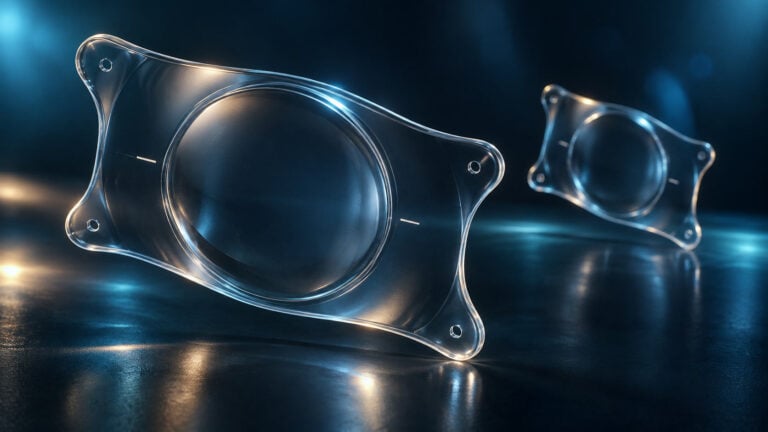
Implantable contact lenses are thin, biocompatible lenses placed inside the eye, behind the iris and in front of the natural lens. Unlike laser eye surgery when compared to contact lenses, which reshapes the cornea, implantable lenses add a new optical element inside the eye.
This allows us to correct refractive error with exceptional precision while preserving the natural structure of the eye.
Once implanted, the lens remains in position permanently and does not require maintenance.
What range of refractive error can implantable contact lenses correct?
Implantable contact lenses are designed to correct a wide range of refractive errors, particularly moderate to high myopia (short-sightedness) and astigmatism. In most modern clinical settings, implantable lenses can correct myopia typically from around −3.00 dioptres up to approximately −18.00 dioptres, and in some cases even higher depending on individual eye anatomy. Toric implantable lenses can also correct significant astigmatism, often up to −6.00 dioptres. Unlike laser eye surgery, which is limited by corneal thickness and structural safety, implantable lenses do not remove corneal tissue. This makes them especially suitable for patients with higher prescriptions or those who are not ideal candidates for laser procedures. The exact safe and effective correction range depends on detailed measurements of the eye, including anterior chamber depth, corneal structure, and overall ocular health, which are assessed during a comprehensive diagnostic consultation.
Who is suitable for implantable contact lenses?
Suitability is determined through detailed diagnostic assessment, but implantable lenses are commonly recommended for patients who:
- Have moderate to high short-sightedness (myopia)
- Have astigmatism
- Are not ideal candidates for laser eye surgery
- Have thin or irregular corneas
- Want long-term vision correction without daily contact lenses
- Experience discomfort or dryness with contact lenses.
Many patients who struggle with contact lens comfort are particularly good candidates, as implantable lenses do not interact with the surface of the eye.
Age is an important factor when considering implantable contact lenses. Most suitable candidates are typically between the ages of 21 and 60, when the prescription has stabilised and the natural lens of the eye is still clear. Implantable lenses are particularly effective for younger and middle-aged adults who want long-term correction without removing the natural lens. In patients over the age of 45 to 50, the natural lens gradually loses its ability to focus at near distances, a normal process known as presbyopia. In these cases, lens replacement with multifocal or trifocal technology may be more appropriate than implantable contact lenses, as it allows both distance and near vision to be addressed. Suitability is always determined individually, based on the clarity of the natural lens, overall eye health, and the patient’s visual goals.
Each patient’s eye structure is carefully measured to ensure safe and appropriate lens placement.
Why implantable lenses provide more stable vision than contact lenses
Contact lenses sit on the surface of the eye and depend on the tear film to function properly. When the tear film becomes dry or unstable, the optical surface changes, and vision can fluctuate.
This is why contact lenses sometimes feel inconsistent. Patients often notice temporary blur, delayed focusing, or reduced clarity after extended wear.
Implantable lenses do not rely on the tear film. Because they are positioned inside the eye, their optical performance remains stable throughout the day.
Patients frequently report that vision feels clearer and more consistent compared to external lenses.

Comfort: eliminating dryness and irritation
Dryness is one of the most common reasons patients stop wearing contact lenses.
Contact lenses can disrupt the natural tear film and reduce oxygen reaching the surface of the eye. Over time, this can lead to irritation, dryness, and discomfort.
Implantable lenses do not touch the cornea. This allows the surface of the eye to function naturally, without interference.
Patients often describe the experience as forgetting they ever needed vision correction at all.
Convenience: removing the daily routine
Contact lenses require daily insertion, removal, and maintenance. This routine becomes part of everyday life, but it also introduces inconvenience and potential risk of contamination.
Implantable lenses eliminate this entirely. Once the lens is implanted, no daily handling is required. There is nothing to insert, remove, clean, or replace. Vision correction becomes continuous and effortless.
Long-term cost comparison
Many patients do not realise how much contact lenses cost over time.
A typical contact lens wearer may spend:
- £300 to £600 per year on lenses
- Additional costs on solutions and replacements
- Over 10 years, this can total £3,000 to £6,000 or more.
Implantable lenses involve a single procedure cost but provide long-term correction without ongoing replacement costs.
Over time, many patients find implantable lenses comparable in cost to long-term contact lens use, while offering greater convenience and stability.
Advantages of implantable contact lenses
From a clinical perspective, implantable lenses offer several important advantages:
- Stable, consistent vision correction
- No daily maintenance or handling
- No dryness associated with surface lenses
- Precise optical correction
- Long-term solution
- Reversible if necessary.
They also preserve the natural corneal structure, which can be beneficial for long-term eye health.
Are there disadvantages?
It is important to present implantable lenses honestly and realistically.
Implantable lens surgery is a medical procedure performed inside the eye. Although it is minimally invasive and highly refined, it still requires careful assessment, surgical precision, and structured follow-up care.
Before surgery, patients undergo detailed diagnostic measurements. These include assessing anterior chamber depth, corneal health, endothelial cell count, and overall ocular anatomy. Proper sizing and placement are critical to ensuring long-term safety and optimal optical performance. This is not a procedure suitable for every eye, which is why thorough screening is essential.
As with any intraocular procedure, there are recognised risks. These may include temporary increases in eye pressure, inflammation during the early healing phase, light sensitivity, or visual fluctuations while the eye adapts. In rare cases, further treatment or lens repositioning may be required. However, modern surgical techniques and careful patient selection significantly reduce these risks.

Recovery typically involves short-term use of medicated eye drops and follow-up visits to monitor healing. Most patients return to normal daily activities quickly, but the eye still requires time to settle fully.
It is also important to understand that implantable lenses correct refractive error, not age-related changes of the natural lens. In younger and middle-aged patients with clear natural lenses, this technology offers excellent long-term stability. However, as the natural lens ages, presbyopia or cataract development may still occur later in life, and this may require future treatment.
When performed in appropriate candidates by experienced surgeons, modern implantable lens surgery is highly predictable and has an excellent long-term safety profile. The key is proper assessment, realistic expectation setting, and structured follow-up care.
A surgeon’s perspective
In my experience, patients who have relied on contact lenses for many years often benefit significantly from implantable lens technology. The ability to provide stable, continuous visual correction without daily handling improves both visual clarity and overall quality of life.
Modern diagnostic technology allows us to assess each patient’s suitability carefully and recommend the most appropriate treatment.
Implantable lenses are not simply an alternative to contact lenses. They represent a long-term solution designed to provide stable, precise vision while preserving the natural structure of the eye.
For many patients, this allows them to move beyond the limitations of daily contact lens wear and experience clear, reliable vision throughout their daily lives.