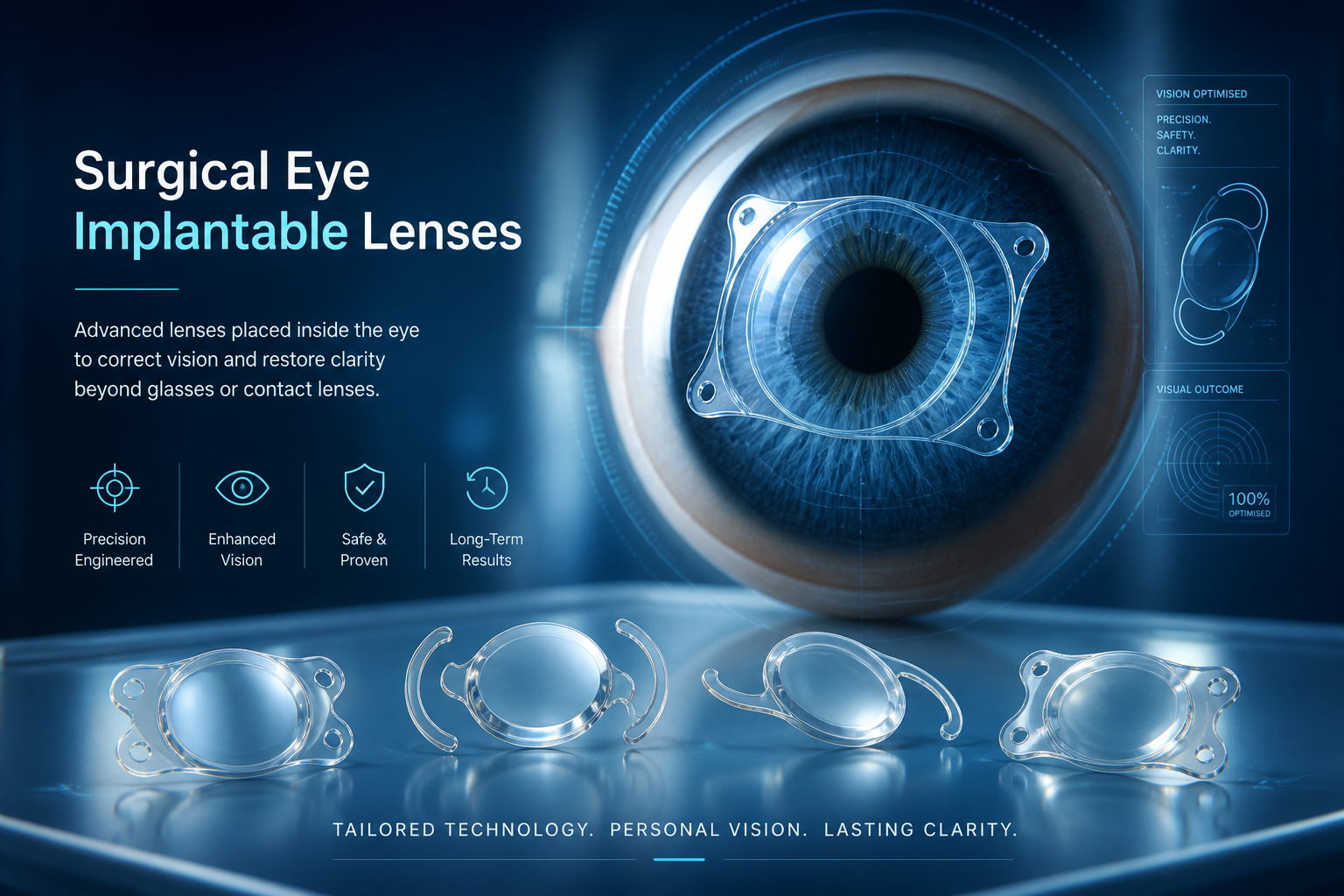
Surgical eye implantable lenses are advanced lenses placed inside the eye to correct vision, either by replacing the natural lens or working alongside it to improve clarity.
Understanding What “Surgical Lenses” Actually Means
Patients often reach this stage with a mix of terms in their head, surgical lenses, artificial lenses, implantable lenses, even “permanent contact lenses”.
They’re all pointing toward the same idea.
A lens placed inside the eye to correct vision in a way that glasses or contact lenses simply can’t.
In clinical terms, these are known as intraocular lenses. The key difference is where they work, inside the eye, rather than on the surface.
What makes this area slightly confusing is that it isn’t just one treatment. It’s a group of advanced lens technologies, each designed for a different purpose. Some replace the eye’s natural lens, others sit alongside it. From the outside, the language can feel fragmented. Once you see how each type fits, it starts to make more sense.
Quick Overview of Surgical Lens Types
| 鏡頭類型 | 它的功能 | 最適合 |
|---|---|---|
| Acrylic IOL | Replaces the natural lens | Cataracts and lens replacement |
| ICL | Sits alongside the natural lens | High prescriptions and thin corneas |
| Toric Lens | Corrects astigmatism | Uneven corneal shape |
| 多焦點鏡片 | Supports more than one focal distance | Distance and reading vision |
Artificial and Acrylic Lenses
The Foundation of Modern Vision Correction
When people talk about “artificial lenses”, they’re usually referring to lenses made from medical-grade materials designed to replace or enhance the eye’s natural lens.
One of the most widely used materials is acrylic.
It might sound simple, but this is a highly refined, medical-grade substance designed to remain stable inside the eye for decades. It doesn’t degrade, it doesn’t cloud, and it maintains its optical precision over time.
That’s why it’s commonly used in cataract surgery and lens replacement procedures.
From a clinical perspective, these lenses aren’t just replacements. In many cases, they offer a step forward. Modern designs can improve vision at different distances, reduce reliance on glasses, and even correct astigmatism.
植入式隱形眼鏡
A Different Approach Inside the Eye
Implantable contact lenses, often referred to as ICL, take a different approach to vision correction. Rather than replacing the natural lens, they are positioned in front of it, working alongside the eye’s existing structure.
These lenses are made from advanced materials such as Collamer, a blend of collagen and polymer technology designed for long-term compatibility. The result is a lens that sits comfortably inside the eye while delivering high levels of visual clarity.
For patients with higher prescriptions, this approach is often more suitable. Clinics such as EuroEyes position ICL as a premium option, not only for its visual outcomes, but because it preserves the natural lens and allows greater flexibility as the eye changes over time.
What Does “Toric Lens” Mean?
“Toric” is one of those terms that comes up a lot, especially if you’ve been told you have astigmatism. In simple terms, it means the lens is designed to correct an uneven curvature in the eye.
A standard lens corrects general short- or long-sightedness, but a toric lens goes a step further. It’s shaped and aligned very precisely to counteract that irregularity, helping light focus more accurately on the retina.
You’ll find toric designs across different types of surgical lenses, including both implantable lenses and replacement lenses used during cataract surgery. From a patient’s point of view, the difference is often subtle but important.
Without astigmatism correction, vision can still feel slightly off. With a toric lens, the aim is to bring that final level of sharpness into focus.
Seeing the Difference Between Lens Types
One of the main challenges for patients is that these terms are often presented in isolation, which can make the whole subject feel more complicated than it really is. A clearer way to understand them is to look at what each lens actually does inside the eye.
Some lenses are designed to replace the natural lens entirely, usually when it has become cloudy or less effective with age. Others are placed alongside the natural lens, enhancing vision without removing anything. There are also lenses developed to address specific visual issues, such as astigmatism or difficulty focusing at near distances.
When you look at them in this context, the differences begin to feel more logical. They’re not just different names for the same thing, they represent different approaches to solving different visual needs.
A Clinical Perspective That Simplifies the Choice
When you strip everything back, the real difference between these lenses isn’t just the materials or the terminology, it’s how they interact with the eye.
Some lenses are designed to replace the natural lens, others enhance it, and some are used to refine specific aspects of vision. The right choice depends on a combination of factors, including your prescription, the structure of your eye, your age, and what you want your vision to look like day to day.
That’s why modern clinics don’t rely on assumptions. Instead, they use detailed diagnostics to map the eye properly before recommending a treatment.
For patients, the terminology can feel overwhelming at first. But once it starts to make sense, something shifts. You realise that vision correction is no longer a single fixed path, it’s a range of tailored solutions designed around the individual eye, not the other way around.
Surgical Lens Terminology: Quick Reference
To make things clearer, here’s a quick reference of the most common terms you’ll come across and what they actually mean in practice.
| Term | Meaning |
|---|---|
| ICL | Implantable Contact Lens placed inside the eye |
| IOL | Intraocular lens that replaces the natural lens |
| Toric Lens | Lens designed to correct astigmatism |
| 多焦點鏡片 | Lens that supports multiple viewing distances |
| Collamer | Biocompatible material used in modern ICL lenses |
A Note from Mr Fadi Kherdaji
“Most people don’t come in asking for a specific lens. They come in because they’re tired of not seeing clearly.
Our job isn’t to sell a treatment, it’s to understand the eye in front of us and choose the option that will still make sense ten years from now.”