Your Cataract Is Being Removed, but How Do You Want to See Afterwards?
Cataract surgery does more than remove cloudy vision. It also gives you an important opportunity to decide how your eyes will focus for the years ahead.
Many people arrive at their cataract consultation expecting one simple decision: whether or not to have the cataract removed. What they may not realise is that removing the cataract is only one part of the procedure. The cloudy natural lens must also be replaced with a clear artificial lens implant. The type and focusing power of that implant can influence whether you see most clearly in the distance, at a computer, while reading or across a wider combination of distances.
This means cataract surgery is not only about restoring brightness and clarity. It can also be an opportunity to reduce an existing glasses prescription, manage astigmatism and plan how you would like to use your vision afterwards.
The question is not simply, “Which lens removes my cataract?”
Every replacement lens restores transparency. The more useful question is, “Which lens best supports the way I want to see?”
Why Does Vision Become Cloudy With Age?
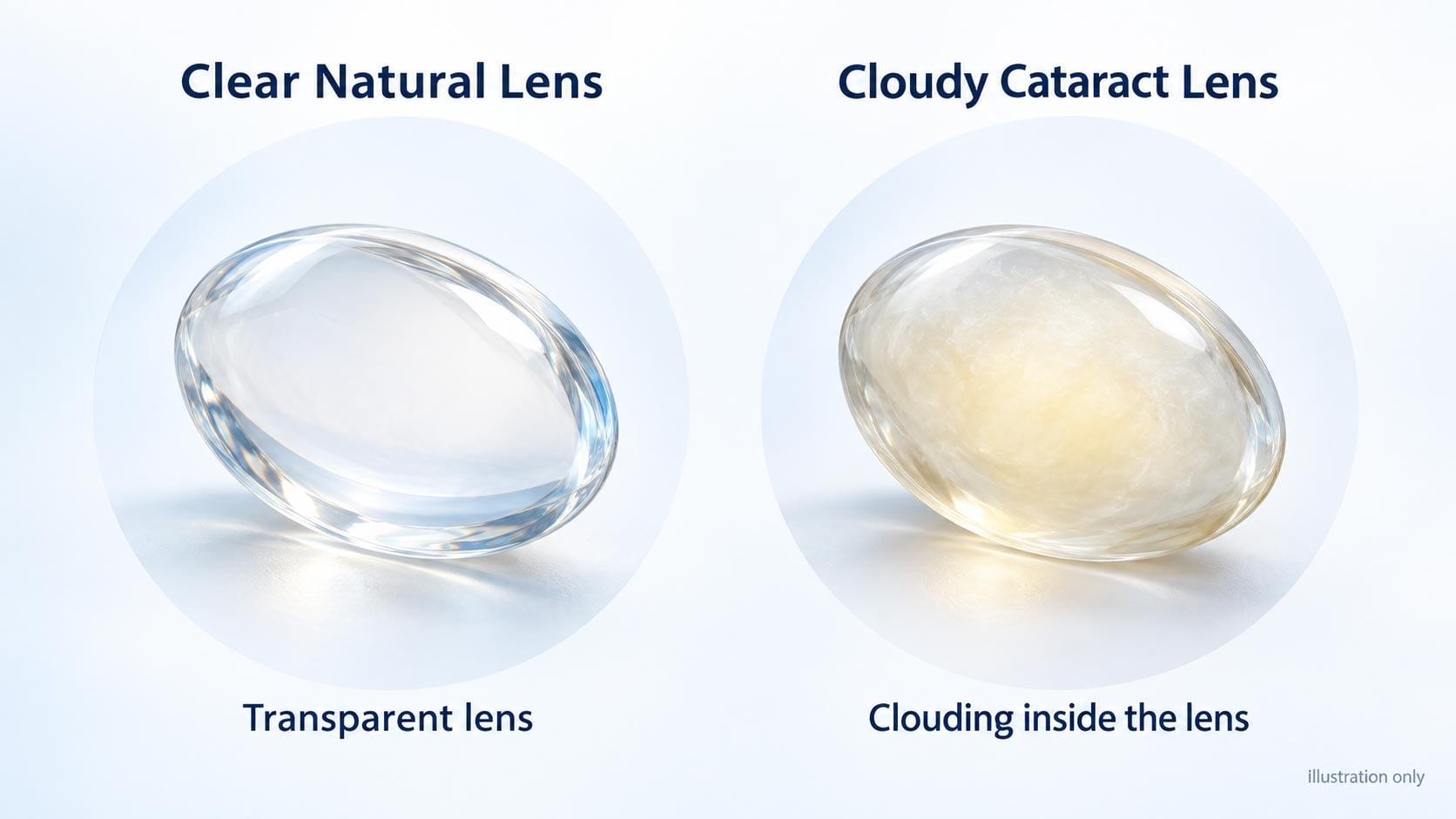
Inside each eye is a natural transparent lens. When you are young, this lens is both clear and flexible. It helps focus light onto the retina and changes shape as you look between distant and nearby objects. As the years pass, two different age-related changes can affect this lens.
Presbyopia: The Lens Becomes Less Flexible
Presbyopia usually becomes noticeable from the 40s onwards. The lens gradually loses its flexibility, making it more difficult to focus on menus, books, phones and other close-up objects. Vision may remain bright and clear, but reading glasses become necessary.
Cataract: The Lens Becomes Cloudy
A cataract develops when proteins within the natural lens change and its transparency deteriorates. Vision can become misty, faded or yellowed. Glare may increase, lights can appear dazzling and driving at night may become more difficult.
Presbyopia and cataracts are not the same condition, although they frequently affect the same person. Presbyopia changes the lens’s ability to focus. A cataract changes its clarity. New glasses can often help with presbyopia and may temporarily improve vision during the early stages of a cataract. However, glasses cannot make a cloudy natural lens transparent again. Once a cataract is significantly affecting everyday life, surgery is the only way to remove it.
What Does Cloudy Cataract Vision Feel Like?
Cataracts tend to develop gradually, so the change is not always obvious. Rather than waking up with suddenly blurred vision, you may slowly adapt to seeing the world through an increasingly misty lens.
What Actually Happens During Cataract Surgery?
The eye’s cloudy natural lens is gently removed through a small opening and replaced with a clear artificial intraocular lens, commonly abbreviated to IOL.
01
The Cloudy Lens Is Removed
The natural lens affected by the cataract is broken into small pieces and carefully removed.
02
A Clear Lens Is Inserted
A folded artificial lens is inserted into the eye and positioned inside the natural lens capsule.
03
Your New Focus Takes Over
The power and design of the implant help determine how your eye focuses after surgery.
The new lens is not an optional extra. Every eye requires a replacement lens after the cataract has been removed. The choice lies in which type of lens is implanted and which visual target is selected.
Your Replacement Lens Options Made Simple
Lens names can initially sound technical. A simpler way to understand them is to consider the distances you use most often and the compromises you would feel comfortable accepting.
You can explore EuroEyes’ complete range of refractive cataract surgery options, but the final recommendation must follow a comprehensive clinical assessment.
Compare the Main Cataract Lens Options
| Lens Option | Distance | Computer Range | Reading | Key Consideration |
|---|---|---|---|---|
| 單焦距 | Strong at the selected focus | Glasses may help | Usually needs glasses | Simple optics with one principal focal target |
| EDOF | Strong | Strong functional range | Fine print may need glasses | Prioritises distance and intermediate vision |
| 三焦距 | Designed to support it | Designed to support it | Designed to support it | Wider range with possible halos or glare |
| Light Adjustable | Can be refined | Depends on the selected profile | Depends on the selected profile | Requires adjustment visits and UV protection |
Choose by Lifestyle, Not Simply by Lens Name
Instead of beginning with technology, begin with the activities that matter to you.
Your answer does not automatically select a lens. It gives your surgeon a better understanding of what a successful result would mean in your life.
Where Does Laser Fit Into Cataract Treatment?
The word “laser” is used in several different ways in eye care, which can create understandable confusion.
Can LASIK or SMILE Remove a Cataract?
No. LASIK, SMILE and similar procedures reshape the cornea at the front of the eye. A cataract is located inside the eye within the natural lens. Corneal laser treatment cannot make that cloudy lens clear again.
What Is Laser-Assisted Cataract Surgery?
A femtosecond laser can be used to assist certain stages of cataract surgery, such as creating precise openings or softening the cataract. The cloudy lens must still be removed and replaced with an artificial lens implant.
Can Laser Fine-Tune Vision Afterwards?
In selected patients, a small remaining glasses prescription may be treatable with LASIK or a surface laser procedure after the eye has healed. This is sometimes called a laser enhancement. Suitability depends on the cornea, prescription and overall eye health.
Is YAG Laser Part of Cataract Surgery?
YAG laser is usually used later if the thin capsule behind the implant becomes cloudy. This is known as posterior capsule opacification or “after-cataract”. YAG laser creates a clear opening in the cloudy capsule, but it does not remove the original cataract or replace the implanted lens.
Why Is There No Single “Best” Cataract Lens?
The most advanced lens is not automatically the most appropriate lens.
A patient who drives regularly at night may have different priorities from someone who reads for several hours each day. A person with an otherwise healthy visual system may be suitable for a wider range of lens designs than someone with changes affecting the cornea, retina or optic nerve.
Your surgeon may consider:
- Your current glasses prescription
- The amount and type of astigmatism
- Corneal shape and optical quality
- Retinal and macular health
- Optic nerve health
- Previous laser eye surgery
- Eye dominance
- Pupil behaviour
- Night-driving requirements
- Reading and screen habits
- Your attitude towards glasses
- Your tolerance for possible halos or glare
Sometimes the safest or highest-quality recommendation will involve continuing to use glasses for certain tasks. Good cataract planning is not about promising that spectacles will never be needed again. It is about selecting the most appropriate balance for your eyes.
Seven Questions to Ask at Your Cataract Consultation
You do not need to arrive knowing which lens you want. These questions can help you understand the recommendation and feel more confident about your decision.
- Which distances are most likely to be clear without glasses?
- Will I probably need reading or distance glasses afterwards?
- Do I have astigmatism that could be treated with a toric lens?
- How could this lens affect night driving, glare or halos?
- Are my retina, cornea and optic nerve suitable for the lens being recommended?
- Would both eyes have the same lens and focusing target?
- If I still need glasses afterwards, what options would be available and would they involve additional costs?
Cataract Lens Options: Frequently Asked Questions
Does Everybody Receive a Lens Implant During Cataract Surgery?
In standard modern cataract surgery, the cloudy natural lens is removed and replaced with an artificial intraocular lens. The implant replaces the focusing power lost when the natural lens is removed. In unusual or complex circumstances, implantation may need to be delayed or a different approach considered.
Can Cataract Surgery Correct My Existing Glasses Prescription?
Yes, the implanted lens power can be selected to reduce short-sightedness or long-sightedness. Toric lenses can also reduce suitable forms of regular astigmatism. The accuracy of the outcome depends on the eye’s measurements, healing and individual anatomy, so complete freedom from glasses cannot be guaranteed.
Can I Have a Trifocal Lens if I Drive at Night?
Some patients drive comfortably with trifocal lenses, but these lenses can produce halos, glare or reduced contrast in low light. These effects may become less noticeable as you adapt, although they can persist. Your night-driving requirements and general eye health should be discussed carefully before selecting a multifocal or trifocal design.
Will a Cataract Come Back After the Natural Lens Has Been Removed?
The original cataract cannot return because the natural lens has been removed. However, the capsule supporting the artificial lens can become cloudy months or years later. This is called posterior capsule opacification and can usually be treated with a YAG laser procedure. Any new blur should be examined to establish its cause before treatment is recommended.
Cataract Surgery Can Be the Beginning of Clearer Vision
Living with cataracts can make the world feel progressively dimmer, less colourful and less certain. Removing the cloudy lens can restore clarity, while choosing an appropriate implant can also help address how your eyes focus.
For suitable patients, cataract surgery can reduce a long-standing prescription, manage astigmatism and provide a visual range that better supports everyday activities.
The decision should never be rushed or based on the name of a lens alone. It should follow detailed measurements, an examination of the complete eye and an honest conversation about what you want from your vision.
YOUR VISION AFTER CATARACTS
Explore Your Cataract Lens Options
Speak to EuroEyes London about your cataracts, your everyday visual needs and the lens options available. A comprehensive cataract assessment will help determine which approach is appropriate for your eyes.
All surgical procedures carry potential risks and limitations. Treatment suitability, recovery and likely visual outcomes vary between patients and can only be assessed following a comprehensive clinical examination.