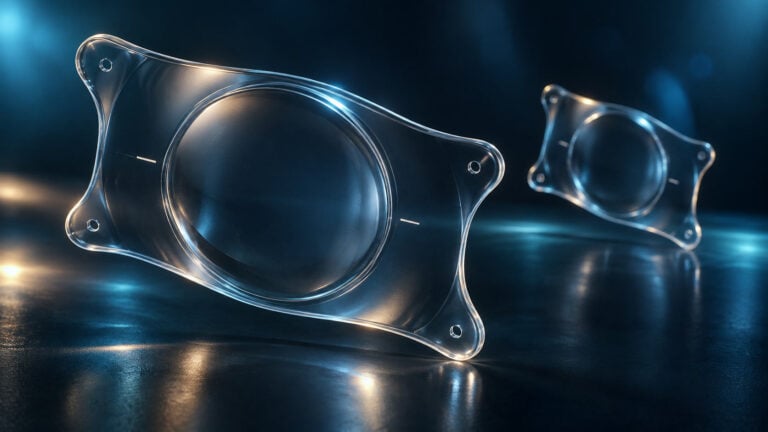
Imagine waking up and seeing clearly without reaching for your glasses or inserting lenses. That’s the reality many are choosing with permanent contact lenses, also known as implantable contact lenses or ICLs.
Unlike traditional lenses you remove daily, these surgical lenses are placed permanently inside the eye, just behind your iris. The result? Clear, lasting vision with no daily maintenance and no dryness from regular contacts.
What Are Permanent Contact Lenses?
Permanent contact lenses are lens implants designed for long-term vision correction. They are often referred to as:
- Implantable contact lenses (ICLs)
- Contact lens implants
- Surgical lenses
- Permanent eye contact lenses
These soft, biocompatible lenses are inserted into the eye during a short outpatient procedure. Once placed, they remain securely in position, invisible to the outside world and comfortable to wear for decades.

What does ICL mean?
ICL stands for Implantable Collamer Lens. The lens is made from a collagen-based material called Collamer that’s highly biocompatible and engineered to work naturally with the eye’s structures.
Who Is This Surgery For?
A lens inside the eye may sound futuristic, but it’s one of the safest and most effective options for:
- People with high myopia or astigmatism
- Patients with thin corneas (often unsuitable for laser surgery)
- Those with chronic dry eyes
- Adults aged 20 to 45 with stable prescriptions
- Anyone looking for a permanent alternative to glasses or contact lenses
The most advanced option today is the EVO ICL, a next-generation lens that allows natural fluid flow inside the eye, reducing the risk of pressure buildup and eliminating the need for pre-treatment with laser.
What Is the Procedure Like?
Also known informally as the IVL operation for the eyes, the ICL procedure is:
- Performed under local anaesthetic
- Completed in 15 to 20 minutes per eye
- Reversible if your needs change in future
How it works:

- A small opening is made in the edge of the cornea.
- The folded lens is gently inserted and placed behind the iris.
- It unfolds into position naturally, without the need for stitches.
Most patients notice a dramatic improvement in vision within 24 to 48 hours, with results often described as clearer and sharper than they had with glasses.
Types of Permanent Contact Lenses
| Lens Type | Description | Who It’s For | Key Features |
|---|---|---|---|
| EVO ICL | Latest generation ICL with central port | Most patients with myopia or astigmatism | No need for pre-op laser, fluid flow friendly |
| Toric ICL | Corrects both nearsightedness and astigmatism | Patients with significant astigmatism | Rotational alignment required |
| Non-hole ICL | Older model without central port | Previously common pre-2020 | Requires pre-op laser treatment |
| Phakic IOL | General term for lenses implanted without removing the natural lens | High prescriptions not suited to laser | Reversible, sits behind the iris |
Is It Truly Permanent?
Many ask, does ICL surgery last forever? While the lenses are designed to stay in place for life, your eyes still naturally age. You may develop conditions like presbyopia (reading difficulty) or cataracts later in life, which would require separate treatment.
That said, the ICL itself does not degrade and can be removed or replaced if your vision needs change. It’s one of the only surgical lenses that combines permanence with flexibility.
Can It Fix Astigmatism?
Yes. Modern ICLs now include toric models that can correct up to 4.0 dioptres of astigmatism, a major step forward for patients who were previously told they had no permanent surgical options.
Toric ICLs are carefully aligned to the specific axis of your astigmatism. Once in place, they provide sharper contrast, better night vision, and greater stability than glasses or laser treatments.
What About Cost?
The average cost of contact lens implants in the UK ranges from £3,500 to £4,500 per eye, depending on the type of lens and your chosen clinic.
Factors affecting cost include:
- The lens model (EVO ICL, toric version, custom)
- Technology used for pre-surgical mapping
- The clinic’s experience and aftercare programme
Many clinics offer interest-free financing or low-interest options, allowing patients to spread the cost across monthly payments while enjoying permanent results.
How Safe Is ICL Really?
When you’re considering surgery inside your eye, it’s natural to wonder what could go wrong. The truth is, serious complications with ICL surgery are extremely rare. In fact, it’s safer than most things you do every day.
How Safe Are ICLs in the UK?
| Risk | Frequency | Notes |
|---|---|---|
| Overall complication rate | <1 in 1,000 | Less than 0.1% |
| Vision-threatening infection (endophthalmitis) | 1 in 10,000 | Extremely rare |
| Cataract formation over 7 years | 6–7% | Mostly in older or high-prescription patients |
| Adjustments/follow-ups needed | 4.8% | Often minor and easily managed |
Common and Less Common ICL Complications
| Complication | Likelihood | What You Should Know |
|---|---|---|
| Halos or glare at night | 24–58% initially | Usually fades to under 15% after a year |
| Temporary increase in eye pressure | 4.4% | Treated with drops or monitoring |
| Early cataract development | Up to 7% | More common in high prescriptions or older adults |
| Retinal detachment | 2% | Linked to high myopia, requires early detection |
| Infection inside the eye | 1 in 6,000 | Extremely rare, needs urgent care |
ICL vs LASIK vs Traditional Contact Lenses
When exploring permanent vision correction, most people weigh up three main options: ICL surgery, LASIK laser eye surgery, and traditional contact lenses.
To help you decide what might suit your eyes and your life best, here’s a comparison:
| Feature | ICL Surgery | LASIK | Daily Contacts |
|---|---|---|---|
| Long-term cost | One-time investment | One-time investment | Ongoing monthly cost |
| Treats high myopia | Yes | Limited by corneal shape | Often not suitable |
| Astigmatism correction | Yes | Yes | Yes |
| Reversible | Yes | No | Yes |
| Induces dry eye? | Very low | Moderate | Moderate |
| Vision in low light | Excellent | May degrade slightly | Varies |
| Maintenance | None | None | Daily |
Summary & Final Thoughts
“The idea of putting a lens inside the eye might sound extreme, but for many patients, especially those with high prescriptions, it’s a safer, clearer, and more comfortable solution than laser. Permanent contact lenses like the EVO ICL have changed what’s possible in modern vision correction.”
Whether you’ve been told you’re unsuitable for laser eye surgery or you’re simply looking for the clearest, most comfortable vision possible, implantable contact lenses could be the game-changer you’ve been waiting for. It’s not just a treatment, it’s a transformation.
– – Dr. Hans-Göran Gustaf Helgason
Consultant Eye Surgeon | ICL Specialist
Ready to See the Difference?
If you’ve been told you’re not suitable for laser surgery or you’re simply ready to ditch your glasses for good, permanent contact lenses could be the solution you’ve been searching for.
Get in touch with us today and ask whether EVO or toric ICL is right for your vision. The future of clarity may already be waiting inside your eye.