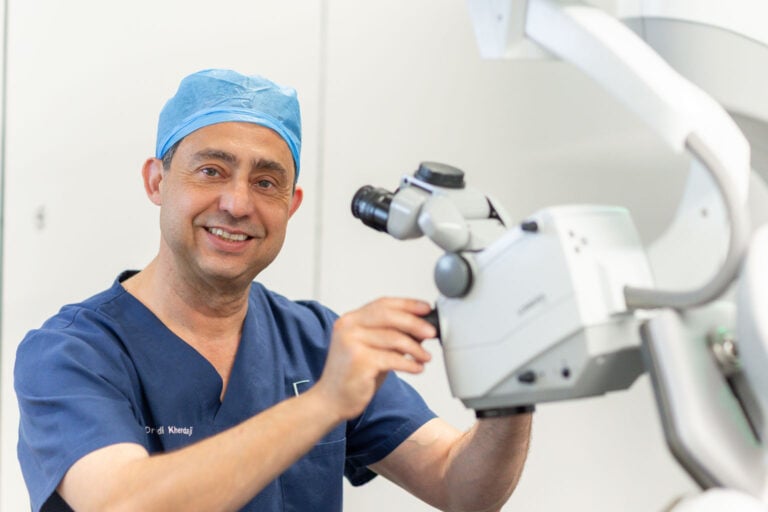
What does an eye surgeon do when he starts to need reading glasses? For Dr Göran Helgason, an experienced EuroEyes surgeon who has spent much of his professional life helping others achieve clearer vision, the answer involved returning to the operating theatre. Only this time, he would be the patient.
Having experienced the benefits of implantable contact lenses (ICL) for almost 30 years, Dr Helgason found himself facing a natural change in his eyesight that affects millions of people across the UK: presbyopia. His story offers a fascinating insight into how our vision evolves throughout life and how modern eye surgery can adapt to our changing visual needs.
Almost 30 Years With Implantable Contact Lenses
In 1997, Dr Helgason was among the early surgeons to work with implantable contact lens technology and among the first patients to experience it himself. At a time when ICL surgery was still relatively new, he placed his trust in the technology not only as a medical professional but also as someone living with short-sightedness. For almost three decades, his implantable lenses provided effective vision correction. During that time, he continued his career in ophthalmology, becoming a leading surgeon for EuroEyes in China and helping patients experience the benefits of modern refractive surgery. However, even the most successful vision correction treatment cannot prevent the natural ageing process of the eye. As the years passed, Dr Helgason began experiencing presbyopia, a condition that gradually reduces our ability to focus on objects at close distances.
When the Roles Are Reversed
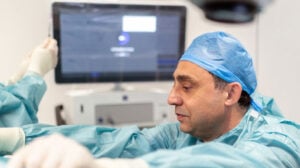
Having spent years working alongside some of the world’s experienced refractive surgeons, Dr Helgason chose his colleague Dr Jørn Jørgensen to perform his lens replacement surgery in Hamburg, Germany, in February 2026. On the day of his procedure, Dr Helgason wore the same handwritten identification label used for patients undergoing surgery at the clinic. It contained three familiar pieces of information: his name, the planned procedure and the surgeon responsible for his treatment.
Usually, Dr Helgason would be the person reading these details before performing surgery. This time, he was sitting on the opposite side of the slit lamp, undergoing his final examination before entering the operating theatre. It is a reminder that behind every surgical procedure is a human experience. Even for someone with decades of medical knowledge, becoming the patient is a very different experience from being the surgeon.
Why Do I Need Reading Glasses After ICL Surgery?
One of the most important things to understand about vision correction is the difference between correcting an existing prescription and preventing age-related changes within the eye.
An implantable contact lens sits behind the iris and in front of the eye’s natural crystalline lens. It changes the way light is focused onto the retina, correcting refractive errors such as short-sightedness and, with suitable lens designs, astigmatism.
Presbyopia, however, develops as the natural lens gradually loses its flexibility. This typically becomes noticeable during our forties, when reading books, looking at mobile phones or working at close distances becomes increasingly difficult. An existing ICL can continue correcting the original prescription, but it cannot restore the natural lens’s youthful focusing ability.
Developing presbyopia after ICL surgery does not necessarily mean the original treatment has stopped working. Instead, it means that another part of the eye has changed naturally over time.
ICL Removal and Trifocal Lens Replacement
One of the distinctive features of ICL surgery is that the implanted lens can be surgically removed if clinically necessary. Unlike laser eye surgery, which permanently reshapes the cornea, the ICL is an additional lens placed inside the eye. For Dr Helgason, the next stage of his vision correction journey involved removing his existing implantable lenses and replacing his natural crystalline lenses with artificial trifocal intraocular lenses. The procedure was performed by Dr Jørgensen in Hamburg.
Combining ICL removal with refractive lens exchange can be an option for carefully selected patients. The suitability of this approach depends on the health of the eye, the patient’s prescription, previous surgery and individual visual requirements.
How Do Trifocal Lenses Work?
Trifocal intraocular lenses are designed to distribute incoming light across multiple focal points, supporting distance, intermediate and near vision. Their purpose is to reduce dependence on glasses across a variety of everyday activities rather than concentrating exclusively on one viewing distance.
Although trifocal lenses can offer a broader range of functional vision, they are not suitable for everyone. Some patients may experience visual disturbances such as glare or halos around lights, particularly at night. These considerations form an important part of the consultation and lens selection process.
ICL Surgery vs Refractive Lens Exchange
Both treatments use advanced implantable lens technology, but they work in fundamentally different ways. Understanding these differences helps explain why a treatment that was appropriate earlier in life may not necessarily be the preferred option several decades later.
| Treatment Feature | Хирургия МКЛ | Lens Replacement |
|---|---|---|
| Как это работает | An additional lens is implanted inside the eye. | The natural lens is replaced with an artificial lens. |
| Natural lens | Retained. | Permanently removed. |
| Typical purpose | Correcting short-sightedness and suitable astigmatism prescriptions. | Correcting refractive errors and addressing age-related visual needs. |
| Reading vision | Standard ICLs do not prevent presbyopia. | Trifocal lenses can support near, intermediate and distance vision. |
| Can it be removed? | The implant can be surgically removed when appropriate. | The artificial lens may be exchanged in selected cases, but the natural lens cannot be restored. |
| Future cataracts | Cataracts can still develop in the natural lens. | A cataract cannot develop in a natural lens that has been removed. |
| Suitability | Determined through detailed ocular screening. | Determined by eye health, age, prescription and visual priorities. |
A Vision Correction Journey Spanning Three Decades
Dr Helgason’s experience demonstrates how vision correction can evolve alongside the natural changes that take place within our eyes. His journey spans an important period in the development of modern implantable lens technology, from the early years of ICL surgery to today’s advanced intraocular lens options.
Does Every ICL Patient Eventually Need Lens Replacement?
No. Many patients retain their implantable contact lenses for the long term and may simply choose to wear reading glasses when presbyopia develops. The arrival of age-related reading difficulties does not automatically mean that an ICL needs to be removed.
Lens replacement may become a consideration when a patient wishes to reduce their dependence on reading glasses or when changes such as cataracts develop within the natural lens. However, further surgery carries its own risks, including infection, inflammation, retinal complications and unwanted visual disturbances.
What If You Have Previously Had Laser Eye Surgery?
Dr Helgason’s story is also relevant to patients who underwent laser eye surgery many years ago. Whether your original treatment involved LASIK, PRK or implantable contact lenses, the natural crystalline lens continues to age.
For patients who are now experiencing difficulties with reading vision, several approaches may be considered, including reading glasses and, where appropriate, further vision correction surgery. Previous laser treatment does not automatically exclude someone from lens replacement, although it can make treatment planning and intraocular lens calculations more complex.
A comprehensive examination is essential to establish the cause of any visual changes and identify the most appropriate options.
From One Generation of Eye Surgeons to Another
Dr Helgason is not the only EuroEyes surgeon to experience refractive surgery from the patient’s perspective. In September 2019, Dr Jørn Jørgensen performed ICL surgery on his own son, Dr Jannik Jørgensen, during the opening of a EuroEyes clinic in Beijing. Seven years later, Dr Jannik shared his experience of becoming the patient, describing the emotions leading up to surgery, the procedure itself and his personal experience of living with implantable lenses.
Together, these two stories offer a personal perspective on the relationship between medical knowledge, surgical experience and the trust that patients place in their chosen surgeon.
Frequently Asked Questions About ICL and Lens Replacement
Can an implantable contact lens be removed after 30 years?
Will I need reading glasses after ICL surgery?
Can I have lens replacement after ICL surgery?
Do trifocal lenses eliminate the need for glasses?
Can I develop cataracts after lens replacement?
Can I have lens replacement if I have never had eye surgery?
Vision Correction That Evolves With You
Our eyesight changes throughout our lives, and the treatment that best suits our eyes at one stage may be different from the treatment we consider several decades later. Dr Helgason’s experience highlights the importance of understanding both the long-term possibilities and limitations of modern vision correction.
At EuroEyes London, our approach is centred on understanding the individual patient, their eye health, their previous treatment history and the visual demands of their everyday life. Whether someone is considering vision correction for the first time or exploring their options following previous surgery, the starting point is a comprehensive clinical assessment.
Advances in implantable lens technology have expanded the range of options available to suitable patients. However, the most important decision remains choosing a treatment that is appropriate for the individual eye, both today and for the years ahead.