For many patients, the word LASIK sounds reassuringly familiar. They know it is one of the world’s most established forms of laser eye surgery. They know friends who have had it. They may even know someone who walked out seeing clearly the very next day.
But once patients begin researching the procedure properly, another word often appears repeatedly online:
The flap.
Suddenly, forums become filled with questions.
- What actually is the flap?
- Does it heal properly?
- Can it move years later?
- Why do some laser procedures use one while others don’t?
At EuroEyes London, UK these are some of the most common questions patients ask during LASIK consultations in London. The reality is that the flap is not something to fear. In fact, it is one of the key reasons modern LASIK recovery is usually so fast and comfortable.
Understanding how it works simply helps patients feel more confident about the procedure itself.
What Is the LASIK Flap
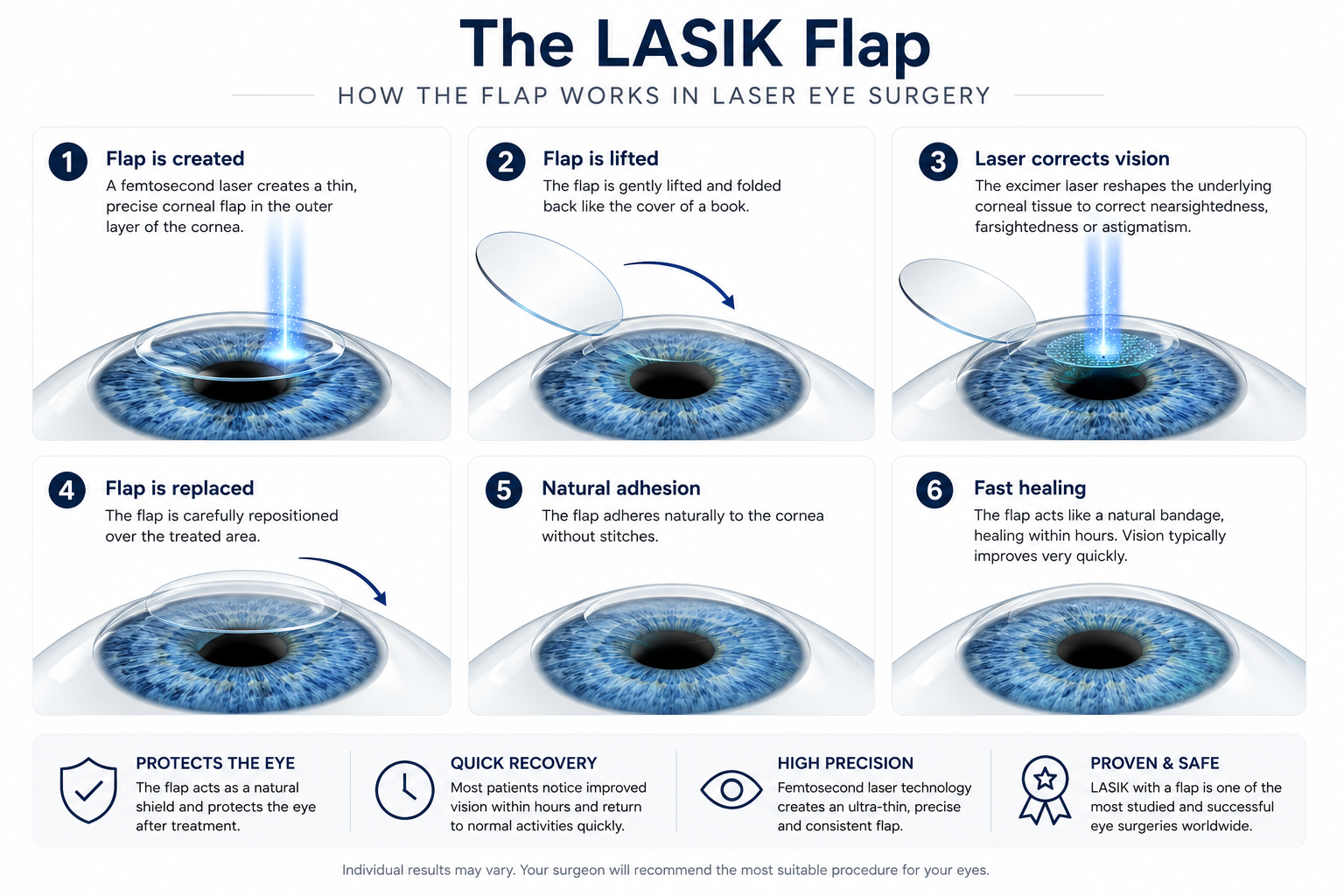
The LASIK flap is an ultra-thin layer created within the outer portion of the cornea during laser eye surgery.
Think of it almost like a natural protective cover. During treatment, the surgeon gently lifts this thin layer to allow the excimer laser to reshape the underlying corneal tissue and correct the patient’s prescription. Once the laser treatment is complete, the flap is carefully repositioned back into place.
It then acts almost like the eye’s own natural bandage while healing begins. Modern LASIK procedures in London now primarily use advanced Femto-LASIK technology, where the flap is created using a highly precise femtosecond laser rather than a mechanical blade. This allows the flap to be smoother, thinner, and significantly more accurate than older LASIK techniques.
Why the Flap Exists in the First Place
Patients are often surprised to learn that the flap is actually one of the reasons LASIK recovery tends to feel so quick compared with older surface laser procedures. Because the upper corneal layer is preserved rather than fully removed, the eye is able to recover under the protection of its own tissue.
This creates several important advantages:
- Faster visual recovery
- Minimal discomfort after surgery
- Lower infection risk compared with surface-based treatments
- No stitches required
- Very little visible scarring
Many patients notice dramatically improved vision within hours of treatment, with functional vision often returning by the following day.
Does the LASIK Flap Heal Properly
Yes. One of the biggest misconceptions online is the idea that the flap remains loose or unstable forever. In reality, the flap begins bonding back into position almost immediately after surgery. The edges heal quickly during the first few hours and days, which is why patients are advised not to rub their eyes early in recovery. Over time, the corneal tissue continues strengthening naturally.
Most patients quickly forget the flap even exists once healing is complete. This is also why modern aftercare instructions matter so much during the first few weeks after surgery. Protecting the eyes properly during this early healing period allows the flap to settle securely and comfortably.
Can the Flap Move After LASIK
Technically, yes! But in modern refractive surgery, it is extremely uncommon.
Immediately after treatment, the flap naturally adheres back into place due to the cornea’s structure and healing response. Once initial healing has occurred, flap displacement becomes very rare.
The highest risk period is usually within the first few days after surgery, which is why patients are advised to:
- Avoid rubbing their eyes
- Use prescribed eye drops carefully
- Avoid swimming temporarily
- Pause contact sports during early recovery
If a flap complication does occur, it can usually be corrected promptly by the surgeon. Importantly, serious flap complications remain rare in modern Femto-LASIK procedures.
How Safe Is Modern LASIK
LASIK remains one of the most studied and frequently performed elective procedures in the world. Modern Femto-LASIK technology has significantly improved both precision and safety compared with earlier generations of laser eye surgery. Large clinical studies consistently show extremely high patient satisfaction rates, with the vast majority of patients reporting they would choose the procedure again.
Complications involving the flap itself are uncommon, particularly when treatment is carried out using modern diagnostic technology and experienced refractive surgeons. At EuroEyes, extensive pre-operative testing is performed to assess corneal thickness, stability, tear quality, and overall suitability before treatment is recommended. That screening process is critical because good outcomes begin with selecting the right patients for the right procedures.
Not Every Patient Needs a Flap Based Procedure
One of the biggest changes in modern vision correction is that LASIK is no longer the only laser option available. Procedures such as SMILE Pro use a minimally invasive approach that does not require a traditional flap at all. Instead, a tiny opening is created within the cornea to remove a small lenticule of tissue, helping preserve more of the corneal surface structure.
This can be particularly attractive for:
- Patients with dry eyes
- Active lifestyles
- Contact sports participants
- Patients wanting minimally invasive treatment
Other patients may be better suited to implantable contact lenses or lens replacement procedures depending on age, prescription strength, or corneal anatomy. That is why personalised assessment matters far more than simply choosing whichever procedure sounds newest online.
What Recovery Feels Like After LASIK
Most patients describe the first few hours after LASIK as surprisingly manageable. Vision is often misty or slightly watery immediately afterwards, similar to looking through steam or a soft filter. Mild irritation, watering, and light sensitivity are common initially but usually improve rapidly.
By the next morning, many patients already notice a dramatic improvement in clarity. For most London patients, recovery becomes less about pain and more about patience, allowing the eyes time to stabilise fully while following the aftercare plan carefully.
LASIK Recovery Timeline
From Blurry to Brilliant
Modern Femto-LASIK is designed for fast visual recovery, with many patients noticing a dramatic improvement within the first 24 hours.
First 4 Hours
Vision may feel misty or watery. Mild irritation, light sensitivity and tired eyes are common, so rest is usually recommended.
24 Hours
Many patients notice a major improvement in clarity by the next day and can often return to light daily activities.
Week One
The eyes continue to stabilise. Dryness, glare and light sensitivity usually begin to reduce as healing progresses.
2–4 Weeks
The flap becomes increasingly secure while the cornea continues settling. Most everyday routines feel much more normal.
1–3 Months
Vision typically reaches its final stable result, with the cornea fully settled and the healing process complete.
Designed for fast visual recovery: your EuroEyes surgeon will give you a personal aftercare plan based on your eyes, treatment type and lifestyle.
Choosing the Right Clinic Matters
The safety of modern LASIK is not simply about the laser itself. It depends heavily on diagnostics, surgical experience, patient selection, and long-term aftercare.
At EuroEyes London, treatments are carried out using advanced ZEISS laser technology alongside detailed corneal imaging and comprehensive suitability assessments. Our surgeons perform high volumes of refractive procedures every year, allowing for exceptional familiarity across both straightforward and complex cases. Most importantly, patients are guided toward the treatment best suited to their eyes, whether that involves Femto-LASIK, SMILE Pro, implantable lenses, or modern lens replacement surgery.
If you are considering laser eye surgery and would like to understand whether LASIK is right for you, our team can guide you through the options during a detailed consultation and eye assessment.