Most people begin to notice the early signs of presbyopia somewhere in their 40s. Restaurant menus become harder to read, text messages appear slightly blurred, and the phone gradually gets held further away to bring words back into focus. At that point, many people begin asking the same question: should you choose reading glasses or varifocals? Or people start to research and want to discover more information on, “What is presbyopia?”
The answer depends largely on how you live, work, and use your vision throughout the day. While some people only need help with close-up tasks, others want a solution that adapts more naturally to modern life without constantly changing glasses.
EuroEyes compares reading glasses and varifocal lenses in detail, explain the advantages and drawbacks of each, and explore the longer-term alternatives now available through modern vision correction surgery.
Reading Glasses vs Varifocals: What’s the Difference?
| 特点 | Reading Glasses | Varifocal Glasses |
|---|---|---|
| 视觉范围 | Near vision only | Distance, intermediate and near vision |
| Everyday Convenience | Limited | Designed for all-day wear |
| Visual Field | Wide and distortion-free | Narrower peripheral zones |
| Adjustment Period | Usually immediate | Several days to adapt |
| Appearance | Similar to standard glasses | No visible lens separation |
| Cost | Lower | 更高 |
In simple terms, reading glasses work well for people who mainly need help with close-up tasks such as reading, using a phone, or paperwork. Varifocals are often preferred by people with more active lifestyles who want a single pair of glasses for multiple distances throughout the day.
It is also worth knowing that glasses are no longer the only option. Modern lens replacement procedures and laser vision correction can now reduce or even remove the need for glasses entirely in suitable patients.
Reading Glasses: A Simple Solution for Close-Up Vision
Reading glasses remain one of the most common solutions for presbyopia. They are designed specifically for near vision, usually around 30–45 centimetres, helping the eyes focus clearly on books, phones, menus, and other close-up objects.
Advantages of Reading Glasses
One of the biggest advantages is clarity. Because the entire lens contains a single prescription, the visual field tends to feel wide, natural, and distortion-free. Many people find them extremely comfortable for long reading sessions. They are also simple to use. There is no adaptation period, no adjustment to multiple focus zones, and no unusual sensation when moving your head or eyes.
Cost is another reason people often begin with reading glasses. Compared with more complex lens designs, they are relatively affordable and widely available.
The Downsides in Everyday Life
The challenge begins when life becomes more dynamic. Reading glasses only correct close-up vision, meaning distance vision remains blurred while wearing them. This often leads to the constant cycle of taking glasses on and off throughout the day. They can also become impractical in office environments. A standard reading prescription may work for your phone but not your monitor, which usually sits further away. Many people find themselves repeatedly adjusting their position or swapping glasses throughout the working day.
And then there is the familiar issue almost everyone experiences eventually — constantly searching for where the glasses were last placed.
Varifocal Glasses: One Pair for Multiple Distances
Varifocal glasses were developed to solve many of the frustrations associated with switching between different pairs of glasses.
Instead of containing a single prescription, varifocal lenses gradually transition between distance, intermediate, and near vision zones, allowing clearer vision at multiple ranges without removing your glasses.
Advantages of Varifocals
For many people, convenience is the biggest benefit. Whether driving, using a computer, checking a phone, or speaking with someone across the room, varifocals allow smoother transitions between distances without interruption. Modern varifocal designs are also far more discreet than older bifocal lenses. From the outside, they look almost identical to normal glasses without visible separation lines in the lens.
Once fully adapted, many wearers find the transition between distances feels relatively natural in everyday life.
The Downsides of Varifocals
Varifocals are not perfect for everyone.
Because the lenses contain multiple viewing zones, there is usually an adjustment period while the brain learns how to use the lens correctly. Some people experience mild dizziness, depth perception changes, or peripheral blur during the first few days.
The reading zone is also narrower than a dedicated reading lens, particularly around the edges. This can occasionally feel restrictive during prolonged close-up work.
Cost is another factor. High-quality personalised varifocal lenses are significantly more expensive than standard reading glasses.
Which Type of Glasses Suits Your Lifestyle?
The choice between reading glasses and varifocals is often less about the prescription itself and more about how you use your eyes day to day.
The Focused Reader
If most of your close-up vision needs involve reading, hobbies, paperwork, or occasional phone use, reading glasses may be perfectly adequate. They provide excellent clarity for near tasks without requiring adaptation.
The Active Professional
If your day regularly involves driving, meetings, computer work, shopping, phones, and moving between different visual distances, varifocals usually offer greater convenience and flexibility.
What About Computer Work?
Modern working life has created a situation where neither reading glasses nor varifocals are always ideal. Computer monitors typically sit further away than standard reading distance, while the intermediate section of varifocals may feel too narrow for prolonged screen use.
For people spending long hours at a desk, specialist occupational or computer glasses are often recommended as an additional solution.
Looking Beyond Glasses
While reading glasses and varifocals can both improve vision, they do not actually treat the underlying cause of presbyopia. They simply compensate for the eye’s natural loss of focusing flexibility.
For patients looking to reduce long-term dependence on glasses, modern refractive surgery now offers several clinically established alternatives.
Trifocal Lens Replacement Surgery
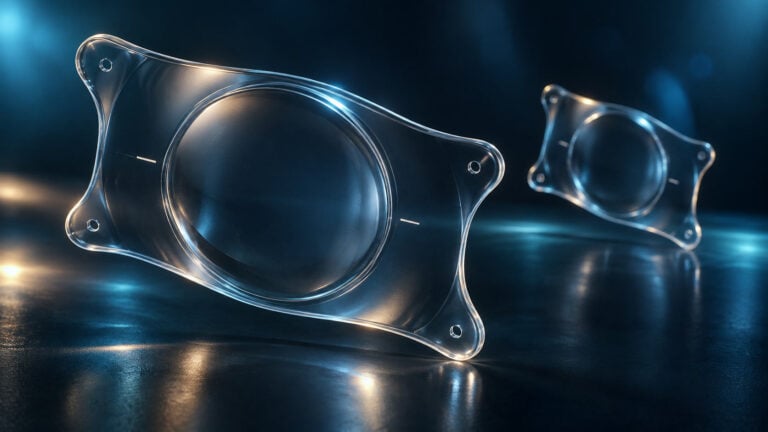
One of the most effective long-term solutions for presbyopia is refractive lens exchange using trifocal intraocular lenses.
During the procedure, the eye’s natural lens is replaced with an advanced artificial lens designed to provide vision at multiple distances.
Why Many Patients Choose Trifocal Lenses
Trifocal lenses are designed to improve distance, intermediate, and near vision simultaneously, reducing reliance on both reading glasses and varifocals. Because the natural lens is replaced entirely, patients also avoid developing cataracts later in life, making it both a vision correction and preventative procedure. For many patients, activities such as driving, travelling, reading, exercising, and using digital devices become far less dependent on glasses afterwards.
Learn more about trifocal lens surgery at EuroEyes
PRESBYOND Laser Vision Correction
For suitable patients without cataracts who prefer a laser-based option, PRESBYOND at EuroEyes offers another approach to treating age-related vision changes.
Using advanced laser technology, PRESBYOND reshapes the cornea to improve vision across different distances while maintaining a natural visual balance between the eyes.
Considering Your Next Step
For some people, reading glasses are enough. For others, varifocals provide a more practical everyday solution. But modern vision correction now gives patients additional options that simply did not exist a generation ago.
At EuroEyes London, our surgeons assess each patient individually to determine the most suitable approach based on lifestyle, eye health, prescription strength, and long-term visual goals.
If you are exploring alternatives to glasses or would like to understand which option may suit you best, you can arrange a consultation with one of our experienced refractive specialists.