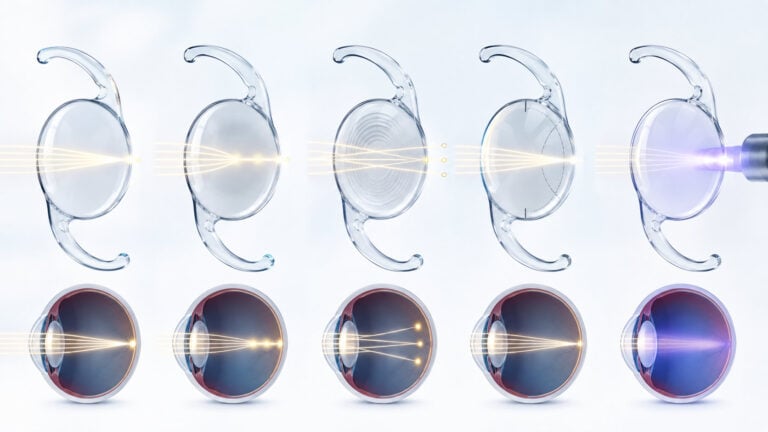
Trifocal implantable lenses and Light Adjustable Lenses are two advanced options for patients undergoing cataract surgery or refractive lens exchange. Both replace the eye’s natural lens, but they approach visual freedom in fundamentally different ways. A trifocal implantable lens is designed in advance to provide near, intermediate and distance vision. The Light Adjustable Lens allows the power of the implanted lens to be refined after surgery, once the eye has healed and the patient has experienced the result in everyday life.
More than one premium solution
Why Does EuroEyes Offer Both Lenses?
There is no single implantable lens that is right for every patient. The best choice depends on the health of the eye, previous surgery, prescription, lifestyle and the distances at which the patient most wants to see clearly.
Different Visual Priorities
Some patients prioritise the widest possible range of vision. Others value precise distance clarity, contrast or the ability to refine their result after surgery.
Different Optical Designs
Trifocal lenses divide light between three focal ranges. The Light Adjustable Lens uses a non-trifocal optical design that can be modified after implantation.
Personalised Selection
Advanced diagnostics allow EuroEyes to assess the cornea, retina, natural lens, eye dimensions and visual requirements before recommending an option.
The Short Answer
A trifocal lens may appeal to a suitable patient who wants near, intermediate and distance vision built into one lens and would like to reduce dependence on glasses across everyday activities.
A Light Adjustable Lens may appeal to someone who prioritises post-operative precision, wants to experience their vision before the final prescription is locked in, or has had previous laser eye surgery that may make conventional lens-power calculations less predictable.
Side-by-side comparison
Trifocal Lens vs Light Adjustable Lens
Both are permanent implantable lenses, but they offer different approaches to vision correction.
| Comparison | 三焦点镜片 | 可调光透镜 |
|---|---|---|
| 工作原理 | Provides near, intermediate and distance focus. | Lens power is refined after surgery using controlled light treatments. |
| Main benefit | A broad range of vision with less dependence on glasses. | A personalised result adjusted after the eye has healed. |
| Near vision | Built into the trifocal optical design. | Depends on the visual target selected during adjustment. |
| Halos and glare | Can occur while the brain adapts to the lens. | The non-trifocal design may reduce these visual effects. |
| 售后服务 | Standard follow-up appointments as the eyes heal. | Additional adjustment visits and UV-protective glasses are required. |
| Long-term use | Designed to remain permanently within the eye. | Permanently secured once the final adjustment is complete. |
On smaller screens, swipe sideways to compare the two lenses.
How Trifocal Implantable Lenses Work
A trifocal intraocular lens contains advanced optics that distribute light across three principal focal ranges. Near vision supports reading, labels, menus and close-up tasks, while intermediate vision covers computers, tablets, dashboards, cooking and conversation distance. The third focal range provides clear distance vision for activities such as driving, watching television, playing sport and seeing signs.
How the Light Adjustable Lens Works
The Light Adjustable Lens contains photosensitive material that allows its optical power to be modified after implantation. It is first placed during cataract surgery or refractive lens exchange, after which the eye is allowed to heal. Controlled light treatments are then used to refine the lens power according to the patient’s visual needs. Once the preferred result has been achieved, final light treatments permanently lock the lens into its finished optical configuration.
Treatment timing
When and How Are These Lenses Used?
Neither lens is placed in front of the natural lens like an ICL. Instead, the eye’s natural lens is removed and the new intraocular lens takes its place.
眼科综合评估
The surgeon assesses the cornea, retina, prescription, eye dimensions, natural-lens health and visual priorities. Previous laser treatment and other eye conditions are also considered.
Cataract Surgery or Refractive Lens Exchange
Both lenses can be implanted when a cataract is removed. They may also be considered during refractive lens exchange when the natural lens is clear but age-related focusing changes or prescription needs make lens surgery appropriate.
Lens Implantation
The natural lens is removed through a small incision and the folded artificial lens is inserted into the remaining lens capsule. It unfolds and is positioned inside the eye.
Healing and Visual Refinement
Trifocal patients begin adapting to their new visual range as the eyes heal. Light Adjustable Lens patients complete a healing period followed by adjustment and lock-in appointments.
Matching the lens to the patient
Which Lens May Suit Which Lifestyle?
These are general examples. They do not replace diagnostics or a recommendation from an eye surgeon.
Trifocal lenses may be considered when:
- Near, intermediate and distance vision are all important
- Reducing dependence on reading glasses and varifocals is a priority
- The eyes are healthy and suitable for a multi-focus optical design
- The patient understands that adaptation, glare or halos can occur
- A built-in range of vision is preferred without a post-operative adjustment programme
The Light Adjustable Lens may be considered when:
- Post-operative precision is a leading priority
- The patient has previously undergone LASIK or PRK
- Conventional lens calculations may be less predictable
- Distance quality and contrast are especially important
- The patient can attend adjustment visits and follow the UV-glasses requirements
Looking beyond recovery
Long-Term Use and Stability
Both lenses are designed as permanent replacements for the natural lens. They do not need routine replacement and cannot develop a cataract themselves.
Permanent Lens Implant
Once implanted and stable, both types are intended to remain inside the eye for the rest of the patient’s life.
Vision Can Still Change
Other parts of the eye can change over time, so no implant can guarantee that glasses or further eye care will never be needed.
Posterior Capsule Changes
Some patients later develop clouding of the capsule behind the implant. Where clinically appropriate, this can usually be treated with YAG laser treatment.
Ongoing Eye Health
Regular eye examinations remain important because retinal, corneal, pressure-related and age-related conditions can still develop.
An important practical difference
The LAL Requires Greater Patient Commitment
The ability to adjust the lens after surgery is a major advantage, but it creates a longer and more involved treatment journey than a conventional fixed lens.
Allow the eye to heal before adjustments begin.
Attend a series of short light-treatment appointments.
Wear the prescribed UV-protective glasses until final lock-in is complete.
Test the vision in everyday life before agreeing on the final target.
Making the decision
Is a Trifocal or Light Adjustable Lens Better?
Neither lens is universally better. A trifocal lens is designed to deliver a broad range of focus from the moment it is implanted. The Light Adjustable Lens prioritises the ability to refine the result after healing and may offer particular advantages where precision is especially important.
The most suitable lens is the one that best balances your eye health, visual priorities, tolerance of optical compromises and willingness to complete the required aftercare. EuroEyes offers both solutions so that the recommendation can be based on the patient rather than limited by the technology available.
Personalised lens assessment
Find the Right Lens for Your Eyes and Lifestyle
Your EuroEyes consultation will assess your vision, eye health and everyday priorities before explaining which premium lens options may be suitable.