Your Eyes Haven’t Gone Backwards
You spent years enjoying life without glasses. Then one evening, in a restaurant with rather questionable lighting, you found yourself holding the menu further away. And further still. What happened?
There is a particular kind of frustration that comes with needing reading glasses after laser eye surgery. Perhaps you had LASIK fifteen years ago. Maybe SMILE more recently. Either way, you remember the freedom of waking up and seeing clearly without reaching for your spectacles. And for years, everything was rather wonderful. Then the small print started getting smaller. Your phone seemed determined to test your patience. Restaurant menus became an exercise in finding the nearest available light source. Naturally, you might wonder whether your laser treatment is beginning to wear off.
The reassuring answer is that it probably isn’t. Something entirely different is happening inside your eyes.
Your Cornea Hasn’t Forgotten What the Laser Did
Think of your eye as a camera. The cornea, the transparent surface at the front, helps bend incoming light. Deeper inside sits the natural lens, which changes shape to bring objects at different distances into focus. When you underwent LASIK or SMILE, the surgeon reshaped your cornea to correct your prescription. That reshaping doesn’t simply disappear as you get older. But the natural lens has its own story to tell. Over the years, it gradually becomes less flexible. The tiny adjustments that once allowed you to switch effortlessly between looking at the horizon and reading a text message or books become increasingly difficult.
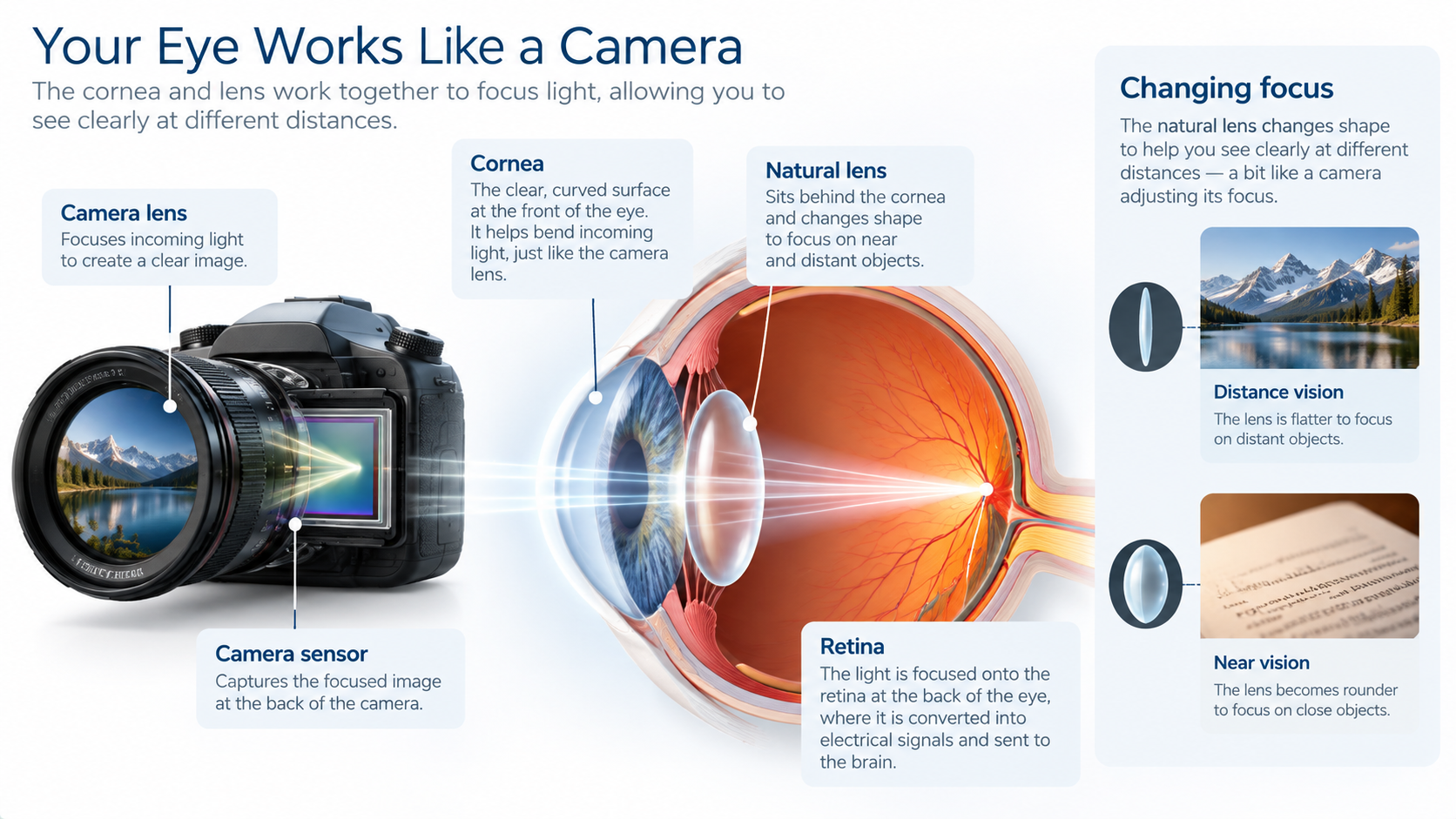
This is called presbyopia. It usually becomes noticeable during your forties, although the timing varies. And it happens whether you’ve had laser eye surgery, worn contact lenses or enjoyed excellent natural vision all your life.
The important distinction is that laser eye surgery corrects a refractive error, but conventional distance correction does not prevent the natural lens from ageing. Your previous treatment hasn’t necessarily failed. Your eyes have simply entered another chapter.
Why an Eye That Has Already Had Laser Surgery Is Different
Here is where the story becomes more interesting, particularly if you’re considering further vision correction. Your cornea carries a history. Even decades after LASIK or SMILE, its shape reflects the treatment you received. That doesn’t usually create a problem for everyday vision, but it matters enormously when a surgeon needs to calculate the power of an artificial lens.
Traditional intraocular lens calculations were largely developed around eyes that had never undergone corneal refractive surgery. After LASIK or SMILE, some of the relationships between the front and back surfaces of the cornea are different. Certain standard calculations can therefore produce less predictable results. A fraction of a dioptre might sound insignificant. When you’re trying to achieve precise vision without glasses, however, small inaccuracies can make a noticeable difference. This is why treating presbyopia in a previously lasered eye requires more than simply choosing a replacement lens. It requires an understanding of the eye’s history, careful measurements and the ability to interpret those measurements correctly.
Thirty Years of Experience, and a New Generation of Patients
EuroEyes began performing laser vision correction in 1995. Across the group, more than 500,000 laser vision correction procedures have been performed. That experience is particularly relevant today, as patients who underwent treatment during the earlier decades of laser surgery are now reaching their fifties, sixties and beyond. Their original treatment may still be providing excellent distance vision, but their visual needs have changed. Some want to read without glasses again. Others struggle with computer screens, driving at night or the constant switching between different pairs of spectacles.
At EuroEyes London, assessing these patients means considering not just what was done to their eyes years ago, but what their eyes need now. Where previous treatment records are available, they can provide useful information. When they are not, modern corneal measurements and specialised post-refractive calculation methods can help surgeons plan treatment.

The aim isn’t to repeat the past. It’s to understand it well enough to make the right decision for the future.
So, Can You Have Vision Correction Again?
Often, yes. But the answer depends on what is actually causing the difficulty. Not everyone who needs reading glasses or varifocals after LASIK requires another operation. In fact, for some people, a simple pair of reading glasses remains the most sensible solution. For others, particularly those seeking greater independence from glasses, further treatment may be worth exploring.
Further Corneal Laser Treatment
In selected eyes, an enhancement or a presbyopia-focused laser approach may be considered. Suitability depends on corneal thickness, stability, previous treatment and visual requirements.
تبديل العدسات الانكسارية
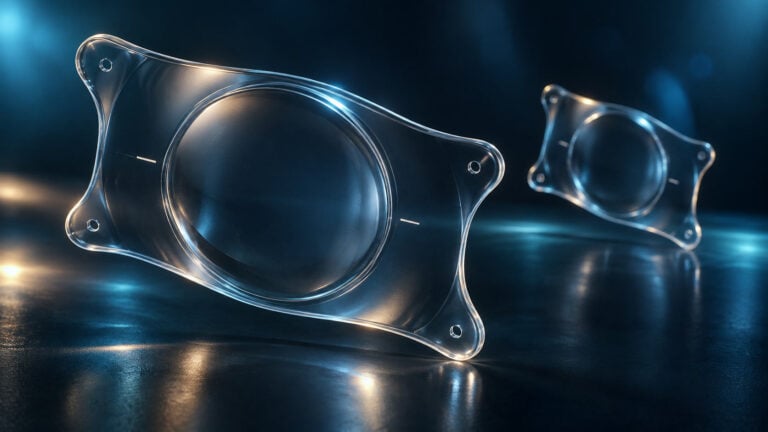
The natural lens is replaced with an artificial intraocular lens. Depending on the eye, options may include monofocal, enhanced monofocal, extended depth of focus or multifocal designs.
A Personalised Approach
Some previously lasered eyes are less suitable for particular lens designs because of optical quality, irregularities or other findings. The best option is not necessarily the most technologically sophisticated lens.
And that final point matters. Modern lens technology offers remarkable possibilities, but no artificial lens reproduces every quality of a young, healthy natural lens. Some designs involve compromises, including halos, glare or reduced contrast sensitivity. A good consultation should explain those trade-offs just as clearly as the potential benefits.
The Question Isn’t Simply Whether You Can See Without Glasses
It’s what you want to see. Consider two people of the same age who both underwent LASIK twenty years ago. One spends their days reading, writing and working at a computer. The other enjoys golf, travelling and driving long distances. Their eyes may look remarkably similar on paper, but their expectations of treatment could be quite different.
For the first, comfortable intermediate and near vision might be the priority. For the second, sharp distance vision and good night-time visual quality may matter more. Neither person is wrong. This is why EuroEyes places importance on understanding how patients use their vision, rather than treating a prescription as though it tells the whole story. A detailed assessment of the cornea, natural lens, retina and overall eye health helps establish which options are appropriate and what outcomes are realistic.
A Second Chapter for Your Vision
There is something rather wonderful about the fact that people who had laser eye surgery decades ago are now returning to explore what modern ophthalmology can offer them. The technology has evolved. Our understanding of previously treated eyes has advanced. And the range of lens options available today is considerably broader than it once was. But one principle hasn’t changed. The best treatment begins with understanding the individual, not selling them a procedure. If your reading glasses have made an unexpected return and you want to get rid of them, don’t assume your original laser surgery has let you down. Your eyes have changed. That’s perfectly natural. What matters now is discovering what those changes mean for you, and whether another stage of vision correction could help.
Your Vision Has a History. Let’s Understand It.
At EuroEyes London, your journey begins with a detailed assessment of your eyes, your previous treatment and the way you want to see the world.
الأسئلة المتداولة
Can I Have Presbyopia Treatment if I’ve Already Had LASIK or SMILE?
Yes, many previously treated patients can be considered for further vision correction. However, suitability depends on the condition of the cornea, the natural lens and the overall health of the eye. A detailed assessment is essential before recommending treatment.
Do I Need the Records From My Original Laser Surgery?
They are useful, particularly when planning lens replacement surgery. Information about your original prescription and corneal measurements can improve surgical planning. If the records are unavailable, specialised modern measurements and post-refractive calculation methods can still help, although some uncertainty remains.
Does Needing Reading Glasses Mean My LASIK Has Failed?
Not necessarily. Presbyopia is caused by age-related changes in the natural lens, whereas LASIK reshapes the cornea. However, a new prescription or deteriorating vision can have several causes, so an eye examination is important.
Can Lens Replacement Surgery Eliminate Reading Glasses Completely?
Some patients achieve considerably greater independence from reading glasses, but results vary. Lens design, previous corneal surgery, eye health and visual expectations all influence the outcome. No surgeon can guarantee complete freedom from glasses at every distance.