Why It Happens, How It Feels, and What Can Actually Be Done About It
Light sensitivity, or photophobia, is one of those symptoms people often dismiss until it starts affecting daily life. It can begin subtly. You find yourself squinting more than usual on a bright day, turning screens down lower than others, or avoiding night driving because headlights feel harsher than they used to. Over time, it becomes less of an inconvenience and more of a constant adjustment.
For some, it’s linked to an underlying eye condition. For others, it’s the result of how light is entering and focusing within the eye. And increasingly, patients are asking whether modern treatments such as laser eye surgery or lens-based procedures can actually reduce it. The answer depends on the cause and that’s where it becomes important to understand what’s really happening inside the eye.
What Light Sensitivity Actually Is
Light sensitivity isn’t a condition on its own. It’s a response.
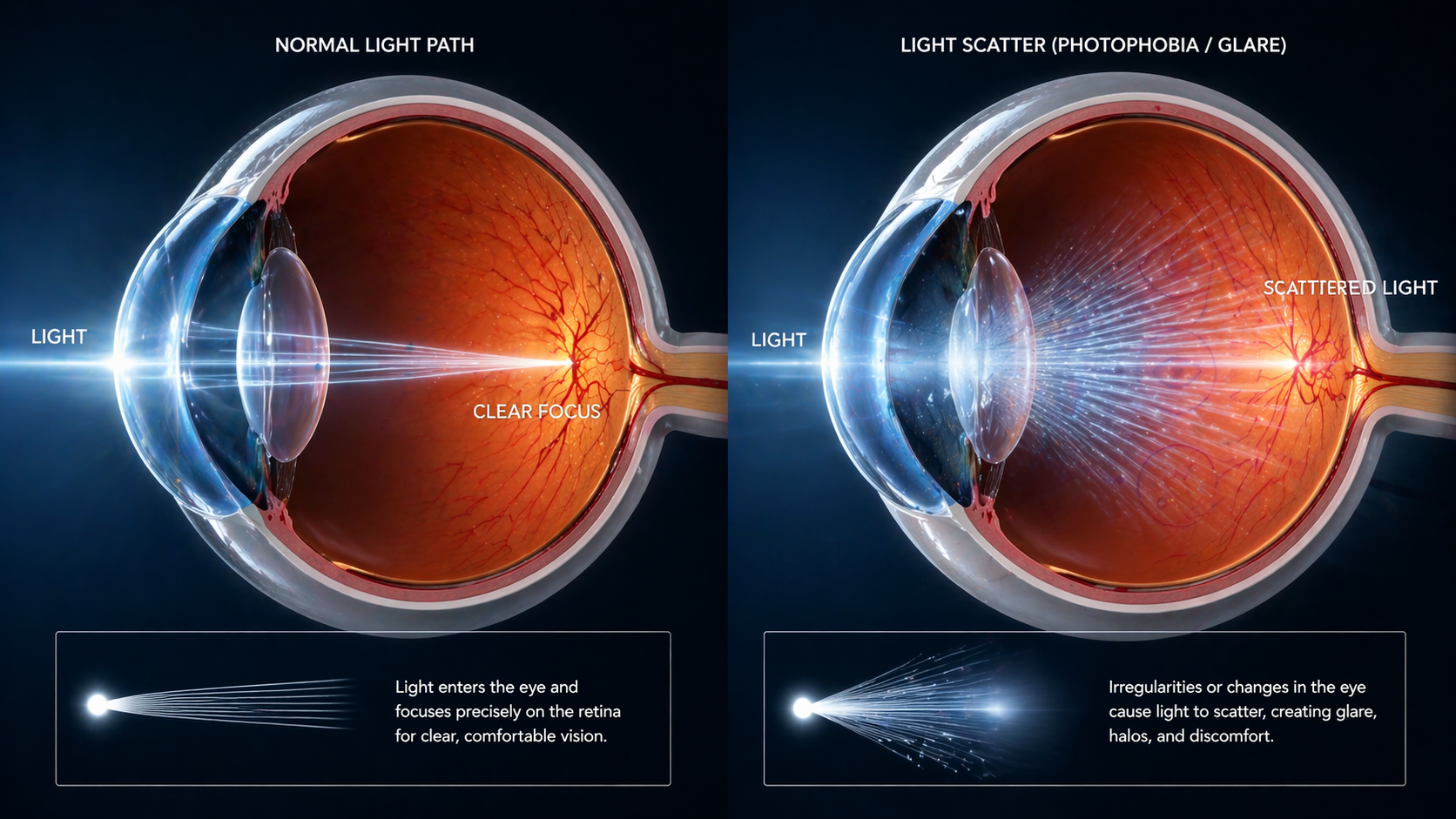
When light enters the eye, it should pass cleanly through the cornea and lens, focusing precisely onto the retina. When that pathway is disrupted, whether through irregular shape, dryness, inflammation, or internal changes, light can scatter instead of focusing cleanly. That scatter is what creates discomfort. It’s why bright environments feel overwhelming, why glare becomes harder to tolerate, and why some patients describe a constant need to shield their eyes even in normal conditions.
Common Causes (And Why They Feel Different)
Not all light sensitivity is the same, and the cause often shapes how it feels.
Dry eye is one of the most common reasons. When the tear film is unstable, the surface of the eye becomes irregular. Light no longer passes smoothly, creating a kind of visual noise that makes brightness harder to tolerate. Patients often notice this more on screens or in air-conditioned environments.
Refractive errors such as myopia or astigmatism can also contribute. When light is not focusing correctly, the eye works harder to process it. This can increase glare and make bright conditions feel more intense than they should.
Then there are structural causes. Early cataracts, for example, can scatter light within the eye, creating glare, halos, and sensitivity, particularly at night. This is often when patients begin avoiding driving in the dark.
Inflammation, migraines, and neurological sensitivity can also play a role, but in a refractive setting, the issue is usually optical, how light is entering and interacting with the eye.
How It Shows Up in Real Life
Patients rarely describe light sensitivity in clinical terms. They describe it through moments, small disruptions that begin to repeat themselves throughout the day.
| Situation | What Patients Experience |
|---|---|
| Bright Light Discomfort | It often starts outside. A normal day feels just a little too bright, causing you to squint or reach for sunglasses sooner than others around you. The light isn’t unbearable, but it feels sharper, more intrusive, as if your eyes are working harder to process it. |
| Screen Fatigue | Indoors, the same sensitivity shows up differently. After a few hours on a laptop or phone, the screen begins to feel harsh rather than comfortable. You lower the brightness, shift your position, take more breaks than you used to. It’s not always obvious at first, but over time it becomes part of how you manage your day. |
| Increased Reliance on Sunglasses | Many patients notice they begin relying on sunglasses more frequently, even in conditions where they never needed them before. It’s less about preference and more about relief. The eyes are simply more comfortable when the intensity of light is reduced. |
| Night Driving Glare | Night driving is where it becomes most noticeable. Headlights appear brighter, less defined, often surrounded by a soft glow or starburst effect. Road signs can feel harder to read, not because they’re unclear, but because the surrounding light interferes with focus. For some, it leads to hesitation or avoiding driving at night altogether. |
| Behavioural Changes Over Time |
What ties all of this together is how gradually it changes behaviour. None of these moments feel dramatic on their own, but they begin to add up. You adapt without thinking, adjusting your environment, your habits, your expectations.
And over time, what started as a mild sensitivity becomes something you work around, rather than something you question. |
Bright Light Discomfort
It often starts outside. A normal day feels just a little too bright, causing you to squint or reach for sunglasses sooner than others around you. The light isn’t unbearable, but it feels sharper, more intrusive, as if your eyes are working harder to process it.
Screen Fatigue
Indoors, the same sensitivity shows up differently. After a few hours on a laptop or phone, the screen begins to feel harsh rather than comfortable. You lower the brightness, shift your position, take more breaks than you used to. It’s not always obvious at first, but over time it becomes part of how you manage your day.
Increased Reliance on Sunglasses
Many patients notice they begin relying on sunglasses more frequently, even in conditions where they never needed them before. It’s less about preference and more about relief. The eyes are simply more comfortable when the intensity of light is reduced.
Night Driving Glare
Night driving is where it becomes most noticeable. Headlights appear brighter, less defined, often surrounded by a soft glow or starburst effect. Road signs can feel harder to read, not because they’re unclear, but because the surrounding light interferes with focus. For some, it leads to hesitation or avoiding driving at night altogether.
Behavioural Changes Over Time
What ties all of this together is how gradually it changes behaviour. None of these moments feel dramatic on their own, but they begin to add up. You adapt without thinking, adjusting your environment, your habits, your expectations.
And over time, what started as a mild sensitivity becomes something you work around, rather than something you question.
Can It Be Treated?
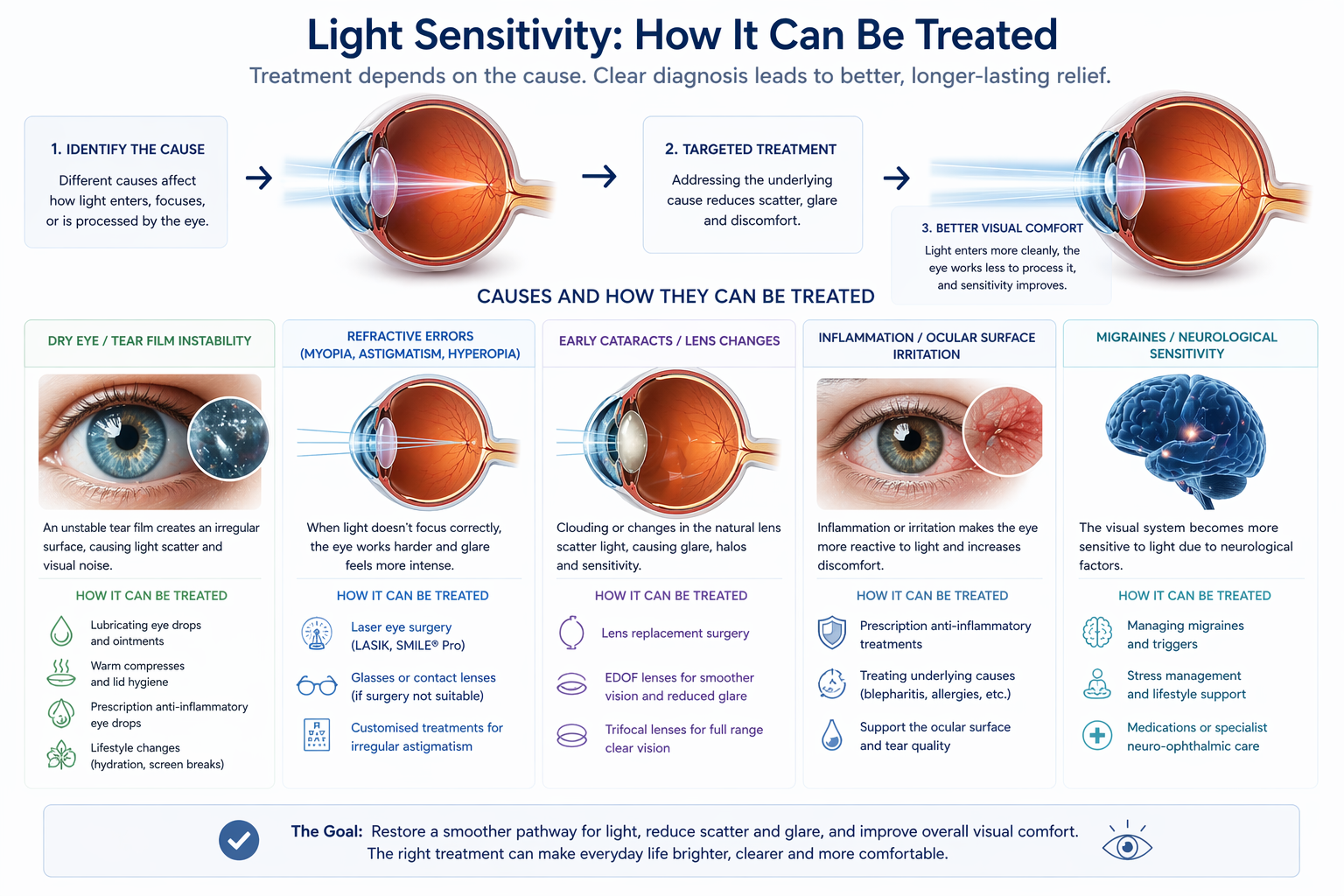
The key to treating light sensitivity is identifying the cause.
If dryness is the issue, stabilising the tear film often makes a significant difference. Lubricating drops, lifestyle changes, and in some cases medical treatments can restore a smoother optical surface. If the cause is refractive, correcting how light focuses in the eye can reduce the strain and scatter that contribute to sensitivity. And if the issue is internal, such as a cataract or lens change, addressing that directly can have a transformative effect.
Where Modern Laser Eye Surgery Can Help
Modern laser eye surgery doesn’t treat light sensitivity directly, but it changes how the eye handles light at its source. By reshaping the cornea with precision, these procedures allow light to enter the eye more cleanly, reducing the scatter and irregular focus that often sit behind glare and visual discomfort.
LASIK: Refining the Optical Surface
Advanced LASIK works by creating a thin flap on the surface of the cornea, allowing the underlying tissue to be reshaped with an excimer laser. The goal is not just to correct vision, but to smooth and refine how light travels through the eye.
For patients who experience light sensitivity linked to refractive error, particularly those with higher prescriptions or irregular astigmatism, this can make a noticeable difference. One patient described struggling with glare on screens late in the day, often needing to dim brightness or step away entirely. After treatment, it wasn’t just that things looked sharper, but that they felt calmer. The harshness had gone, replaced by a more balanced, comfortable visual experience.
Because LASIK allows for highly customised treatments, including wavefront and topography-guided approaches, it can address subtle irregularities that contribute to light scatter. When those irregularities are reduced, the eye no longer needs to work as hard to process incoming light.
SMILE® Pro: A More Natural Light Path
SMILE® Pro takes a different approach. Instead of creating a flap, it works within the structure of the cornea, removing a small lenticule of tissue through a micro-incision. This preserves more of the corneal surface and its natural stability.
For patients with light sensitivity linked to dryness or surface disruption, this can be particularly beneficial. Because the outer layers of the cornea remain more intact, the tear film tends to stay more stable, creating a smoother pathway for light to enter the eye.
One patient, who had always struggled with bright environments and dry eyes, noticed that after SMILE® Pro, it wasn’t just the clarity that improved. Bright light felt less aggressive, more manageable. Walking outside no longer required the same immediate reaction, and long periods on screens became more comfortable without constant adjustment.
The difference isn’t always dramatic in a single moment. It’s something that builds over time, as the eye settles into a more natural way of handling light.
The Underlying Shift
In both cases, the outcome goes beyond vision correction alone. By improving how light is focused and reducing irregularities in the optical system, these treatments can indirectly reduce the conditions that lead to glare, halos, and sensitivity.
The result is not just clearer sight, but a more comfortable relationship with light itself, something patients often notice more in how they feel than in what they see.
Lens-Based Solutions and Light Sensitivity
In patients over 40, or those beginning to experience early changes within the natural lens, laser eye surgery is not always the most appropriate route. At this stage, the issue is often no longer just how light enters the eye, but how it behaves once it is inside.
This is where lens-based treatments come into focus.
Lens Replacement Options
Lens replacement surgery works by removing the eye’s natural lens, which may have started to lose clarity or scatter light, and replacing it with a precisely engineered artificial lens. Unlike glasses or laser treatments that adjust focus externally or on the cornea, this approach changes the internal optics of the eye itself.
For patients experiencing early cataract changes or increasing light sensitivity, this can have a significant impact. One patient described avoiding evening driving altogether due to glare from headlights. After lens replacement, it wasn’t just that their vision became clearer, but that the intensity of light itself felt more controlled. The sharpness returned, but so did a sense of visual comfort that had been missing.
EDOF Lenses: Smoother Vision, Reduced Light Disturbance
Extended Depth of Focus (EDOF) lenses are designed to create a continuous range of vision, particularly from distance to intermediate, while maintaining a more natural light profile.
For patients who are sensitive to glare or concerned about night-time disturbances, EDOF lenses can offer a more balanced experience. Rather than splitting light into multiple focal points as some lenses do, they stretch and smooth the focus, which can reduce the intensity of halos and glare in certain lighting conditions.
A patient working long hours on screens described the difference as subtle but important. The clarity was there, but more noticeably, the strain had reduced. Bright environments felt less overwhelming, and transitions between lighting conditions became easier to handle.
Trifocal Lenses: Full Range with Modern Refinement
Trifocal lenses are designed to provide clear vision at near, intermediate, and distance ranges, offering a high level of independence from glasses.
Earlier generations of multifocal lenses were sometimes associated with glare or halos, but modern trifocal designs have improved significantly. Light distribution is more refined, and for many patients, the benefits of full-range vision outweigh the initial adaptation period. One patient explained that before surgery, bright lights at night felt scattered and difficult to process. After adapting to their new lenses, those same lights became more defined and easier to navigate around. Not necessarily dimmer, but clearer, more structured.

A Different Kind of Outcome
What lens-based treatments offer is not just improved focus, but a change in how light is experienced within the eye.
By removing a lens that may be causing internal scatter and replacing it with one designed for clarity and stability, the overall visual system becomes more efficient. For many patients, this leads to a noticeable reduction in light sensitivity, particularly in situations that once felt challenging.
Good vision is clarity
Light sensitivity is often a symptom that people learn to live with, adjusting their behaviour without fully understanding why. But in many cases, it isn’t something that has to be managed indefinitely. With the right diagnosis, and the right treatment approach, whether that’s managing dryness, correcting refractive error, or addressing changes within the lens, it’s possible to reduce not just the intensity of light, but the impact it has on daily life.
Because good vision isn’t only about clarity.
It’s about comfort.